
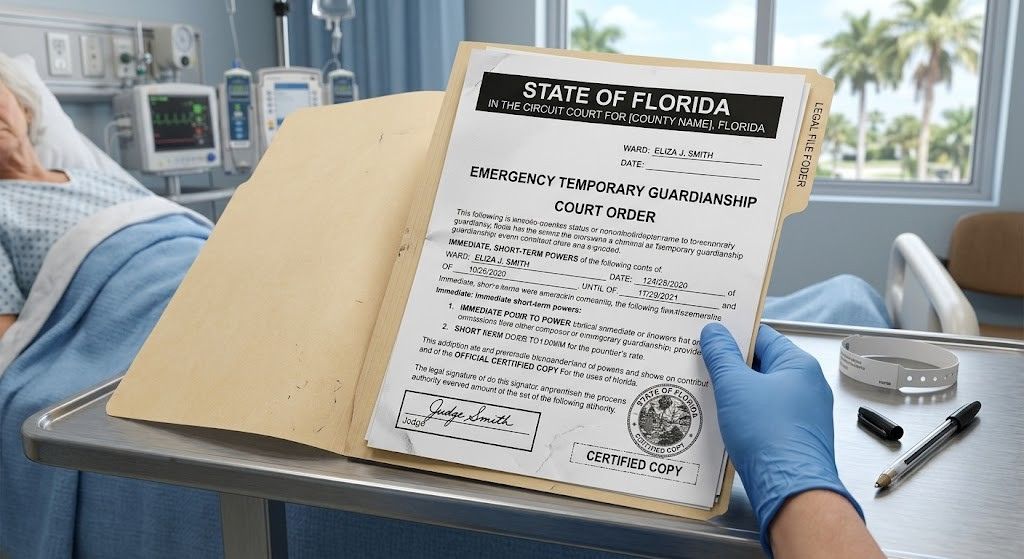
Emergency Temporary Guardianship is a court-approved, short-term legal fix that gives someone authority to make urgent decisions when a child or vulnerable adult cannot safely wait for a full guardianship case. In a health crisis, that authority matters because delays can leave you unable to approve treatment, arrange care, or protect assets at the exact moment decisions need to happen.
What Is Emergency Temporary Guardianship During an Urgent Health Crisis?
Think of Emergency Temporary Guardianship as a legal bridge. It does not permanently hand over control, and it does not erase a person’s rights any longer than the crisis requires. Instead, it gives temporary court control so medical, safety, or placement decisions can be made right away.
Florida treats guardianship as a serious step, not a default answer. A guardian is a court-appointed decision-maker for a minor or an adult with disabilities, and the court only steps in when a less restrictive option does not work. That is why an urgent petition must show more than stress or family disagreement, it must show real necessity.
How Emergency Temporary Guardianship Differs From Permanent Guardianship
Temporary emergency authority solves the immediate problem. Permanent guardianship follows a fuller legal process, usually after the court decides the person lacks capacity for certain or all rights. In Florida, that distinction matters because a limited guardianship removes only some decision-making power, while a plenary guardianship transfers all delegable rights after incapacity is found.
A temporary order is narrow by design. It exists to stabilize the situation first, then let the court decide whether anything broader is still needed. That is the difference between putting out a fire and rebuilding the house.
Why Courts Treat It as a Last Resort
Florida courts follow a least-restrictive-alternative approach. If a durable power of attorney, designation of healthcare surrogate, trust authority, parental consent, or another directive already solves the problem, the court does not need to create temporary court control.
That is the correct policy. Guardianship protects vulnerable people, but it also takes away autonomy. The law demands proof that the other tools are unavailable, ineffective, or too slow for the crisis at hand. Families often learn this too late, which is why guardianship alternatives belong in every serious planning conversation.
When Emergency Temporary Guardianship Becomes Necessary
These cases usually begin with a crisis, not a long-term plan. A person suddenly becomes unable to decide, communicate, or protect personal safety, and no one else has legal authority to act fast enough.
Health Crises That Require Immediate Legal Authority
Stroke, trauma, ICU admission, psychiatric crisis, severe infection, and rapid cognitive decline create classic emergency filings. Someone has to consent to treatment, approve discharge planning, coordinate placement, or authorize records release right away. Hospitals do not wait for uncertainty to clear itself.
Mental health emergencies can be especially difficult. Emergency departments often have the right setting for immediate intervention, but prolonged stays raise safety and treatment problems (HSSIB). In that setting, clear legal authority often decides whether care moves forward or stalls.
Situations Involving Children in Nonparental Care
A child needs temporary guardianship when a parent is absent, unreachable, incapacitated, or refusing to act. School enrollment, medical consent, and day-to-day safety cannot sit on hold while adults sort out family logistics. Pew reports that about 3.7 million U.S. children, or 1 in 20, live in households without a parent as the primary caregiver (Pew Research Center).
For children, the court focuses on care, education, health, and welfare. A temporary filing puts one responsible adult in charge long enough to keep the child stable.
Situations Involving Incapacitated Adults
An adult crisis often starts with a hospital call, a confused discharge planner, or a caregiver who can no longer manage the situation. Emergency temporary guardianship can protect an adult who cannot handle personal or medical decisions, and the court may grant only the powers needed for the crisis.
That targeted approach matters. If the issue is medical consent, the order should not sweep in financial control unless the facts demand it.
What Florida Courts Look For Before Granting Emergency Relief
Urgency alone does not win the case. The petition must show immediate risk, an inability to act, and no workable alternative.
Evidence of Immediate Harm or Irreparable Risk
Courts look for facts, not drama. Untreated medical needs, unsafe living conditions, exploitation risk, inability to consent to treatment, and refusal or failure to provide necessary care all support emergency relief. A good urgent petition tells the court exactly what goes wrong if no one gets authority today.
Proof That No Less Restrictive Option Works
Before filing, the court expects you to consider existing authority. That means checking for a durable power of attorney, health care documents, trust provisions, parental consent tools, or even a prior Florida Guardianship Process filing that already addressed the issue. If one of those documents solves the problem, emergency guardianship is the wrong tool.
Limited Versus Plenary Authority in an Emergency
Florida recognizes both limited and plenary concepts, and the court can tailor relief to match the crisis. That is a good thing. It preserves rights where possible and keeps the order focused on the actual emergency instead of turning a medical problem into total loss of control.
How the Emergency Temporary Guardianship Process Works
The process moves quickly, but it is still a court process. Speed does not remove the need for a clean petition, supporting documents, and due process.
Filing the Petition and Supporting Documents
The petition should include sworn facts, medical records when available, and a clear explanation of why the danger cannot wait. Incomplete filings slow everything down. In urgent cases, that delay matters as much as the legal mistake.
Notice, Hearing, and Court Review
Courts still balance speed with fairness. Notice and hearing rules remain part of the process, even when the judge moves fast. The court’s job is to confirm that the crisis is real and that the requested authority fits the emergency.
What Happens After the Order Is Entered
Once the order is signed, institutions usually want to see it before honoring the guardian’s authority. That means you often need immediate follow-through with hospitals, facilities, and, when finances are involved, banks or title companies. In Broward and Miami-Dade County matters, that rapid response can make the difference between stabilizing a situation and watching it worsen.
The Powers and Limits of a Temporary Guardian
A temporary guardian can act only within the authority the court grants. That sounds obvious, but it is where many families get tripped up.
Medical and Personal Decision-Making Authority
The order may allow consent for treatment, access to records, discharge decisions, and care coordination. It can also cover placement and safety planning. In practice, that means one person can finally answer the questions a hospital has been asking for hours.
Financial and Property Authority, When Granted
Financial authority is not automatic. If the court grants it, the order should be specific, because property access creates abuse risk fast. For asset protection concerns, a Florida Revocable Living Trust or other planning tool often prevents the need for emergency control over accounts and real estate.
Court Oversight and Ongoing Accountability
Guardianship is supervised. A Court Appointed Guardian owes duties to the ward and must operate within the court’s limits. That oversight protects the person, but it also means misuse, self-dealing, or drift beyond the order can be challenged quickly.
How Long Emergency Temporary Guardianship Lasts
Temporary guardianship lasts only long enough to address the emergency. Once the crisis stabilizes, the court revisits the arrangement and decides whether to narrow, extend, or end it.
What Happens When the Crisis Stabilizes
If the person regains capacity or another legal tool becomes available, the temporary order should end or shrink. If ongoing incapacity remains, the court may move toward a fuller guardianship process.
Why Periodic Review Protects Autonomy
This is where planning matters. Rights should return as soon as the need for intervention ends. That principle keeps temporary court control from turning into permanent dependency.
How Emergency Temporary Guardianship Fits With Estate Planning
Most emergency filings happen because planning was missing, outdated, or inaccessible. That is the part families regret later.
Documents That Reduce the Need for Emergency Court Action
A durable power of attorney, health care surrogate designation, living will, trust, and pre-need designation can cover a surprising amount of ground. A Pre-Need Guardian Designation also helps by showing the court who you trust before a crisis ever starts.
Why Families Still End Up in Court During Crises
Documents get lost, hospitals refuse informal authority, family members disagree, or the paperwork was never signed correctly. Florida courts also reject assumptions. If authority is not clear on paper, the court process takes over.
Planning Ahead to Protect Assets and Autonomy
That is the strategic lesson. Good planning keeps control with you longer, protects family assets, and cuts down the need for emergency filings when life turns unpredictable.
Common Problems Families Face in Emergency Cases
The law is only part of the story. Access, timing, and paperwork often create the real bottleneck.
Confusing Forms and Uneven Court Instructions
Guardianship paperwork is hard to assemble under pressure. Families often face unclear forms, missing instructions, and limited digital help. Pew found that many states still fail to provide plain-language guidance for guardianship filings (Pew Research Center), and that problem shows up every time an urgent petition lands on a busy desk.
Delays in Hospitals, Facilities, and Banks
Hospitals want legal authority before they act. Banks and title institutions want the same thing. When records, treatment, or property decisions are on the line, every hour without clear authority adds risk.
Family Conflict and Competing Decision-Makers
Emergency cases also bring out conflict. If more than one person claims authority, the court decides who can act. That is exactly why a contested guardianship Florida dispute can derail even a strong petition if the facts are not organized from the start.
Emergency Temporary Guardianship and Children Versus Adults
The basic idea stays the same, but the legal focus changes depending on who needs protection.
Minor Guardianship in Urgent Situations
For children, the court centers on safety, schooling, medical care, and daily stability. The issue is not just custody, it is who can legally make decisions now.
Adult Guardianship in Urgent Health Crises
For adults, the focus shifts to incapacity, medical urgency, and preserving rights wherever possible. Florida law keeps returning to the same rule, use the least restrictive arrangement that actually works. That is the backbone of Florida Guardianship Laws.
Questions You Should Ask Before Filing
Is There a Faster Alternative Already in Place?
Check for powers of attorney, health care directives, trust authority, or other documents before you file. If one works, you avoid court delay and preserve autonomy.
What Rights Need Immediate Protection?
Identify the exact decisions at stake. Medical care, discharge, placement, finances, and records access are not the same thing, and the petition should match the problem.
Who Can Support the Petition With Medical and Factual Proof?
Doctors, hospital staff, caregivers, school personnel, and other witnesses can establish the emergency. Strong facts move faster than emotional pressure.
Frequently Asked Questions
What is the main purpose of Emergency Temporary Guardianship?
It gives someone legal authority to make urgent decisions when a child or vulnerable adult cannot wait for a full guardianship case.
Does emergency guardianship remove all rights?
No. The court can limit the order to the exact powers needed, and that narrower approach protects more autonomy.
Can emergency guardianship cover finances?
Only if the court specifically grants financial authority. Medical authority does not automatically include access to property or bank accounts.
How fast does the court act?
Emergency cases move faster than standard guardianship matters, but the court still requires a filing, proof, and due process before granting temporary court control.
What documents can prevent emergency guardianship?
A durable power of attorney, health care surrogate designation, living will, trust, or pre-need guardian designation can remove the need for court intervention.
When should you seek legal help?
You should act immediately when a medical crisis, incapacity, or asset risk leaves you without clear authority. In South Florida, that is exactly when rapid, precise legal work protects both the person and the family’s long-term interests.
When a crisis hits, the real question is not whether guardianship sounds available. The question is whether you have a faster, narrower, lawful tool already in place, because that is what preserves autonomy and prevents an emergency from becoming a permanent court problem.
References
- agsjournals.onlinelibrary.wiley.com
- courts.alaska.gov
- courts.michigan.gov
- gac.illinois.gov
- hssib.org.uk
- peoples-law.org
- pew.org
- supremecourt.ohio.gov
- washingtonlawhelp.org