
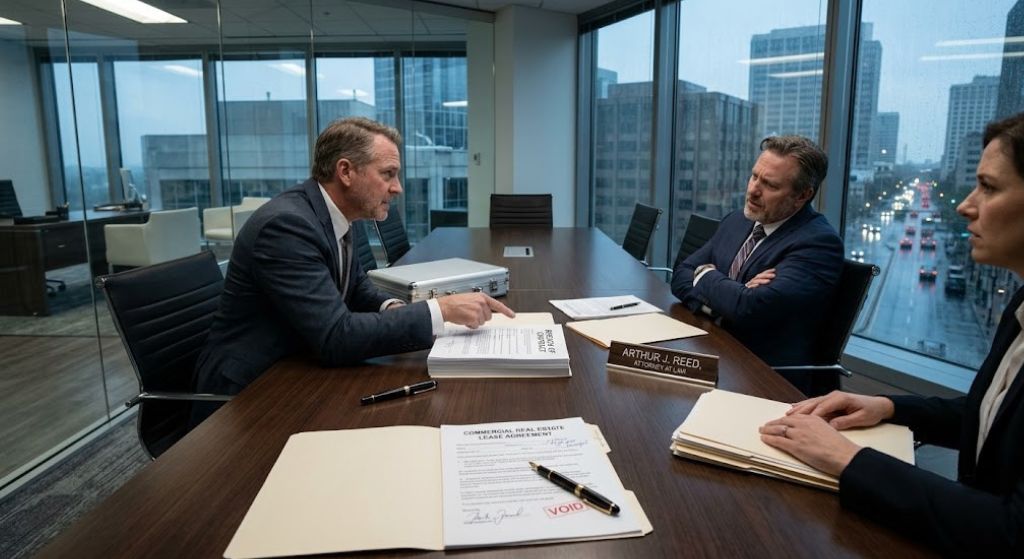
A Commercial Real Estate Breach of Contract happens when somebody in a property deal does not do what the agreement requires, does it late, or flat-out refuses to do it. If you own, lease, buy, or develop property in Broward County, that matters fast, because one missed closing in Fort Lauderdale or one failed build-out in Hollywood can turn a promising deal into a very expensive mess.
What Counts as a Commercial Real Estate Breach of Contract in Broward County
In plain English, a breach means the deal said one thing and reality went another way. Maybe a seller did not transfer clear title. Maybe a tenant stopped paying rent under a commercial lease. Maybe a developer missed a deadline that was tied to permits, financing, or occupancy. The label sounds formal, but the problem is simple: somebody did not hold up a side of the bargain.
In Broward County commercial deals, this shows up in all kinds of agreements. Purchase and sale contracts are the obvious example, but the same idea applies to leases, option agreements, escrow instructions, construction-related promises, and pre-closing obligations tied to due diligence or financing. The contract is the playbook. If the playbook says one thing and performance does another, you may be looking at a breach.
The basic pieces of a valid contract
For a contract to mean anything, it usually needs a few basic parts: an offer, an acceptance, consideration (that just means something of value is being exchanged), clear enough terms, and signatures or some other valid way of showing agreement. Without those pieces, the fight may not even be about breach yet. It may be about whether a real contract existed in the first place.
Here’s the thing: remedies depend heavily on the actual wording. A signed agreement with a detailed default section gives you a very different path than a loose email chain with missing terms.
Commercial deals where breaches show up most often
Commercial real estate disputes tend to cluster around the same pressure points. Sales contracts fall apart over deposits, financing deadlines, title objections, and closing conditions. Leases break down over rent, repairs, delivery dates, and tenant improvements. Build-out disputes usually involve scope, timing, and who pays for what when costs rise.
Escrow disputes are another common one. So are fights over due diligence promises, estoppel certificates, and conditions that must be met before money changes hands.
Common Types of Contract Breaches You May Run Into
Not every breach carries the same weight. Some problems kill the deal. Some are annoying but fixable. That distinction matters because your remedy often turns on how serious the breach is.
Material breach
A material breach is the big one. It goes to the heart of the agreement and undercuts the whole deal. If a seller cannot deliver clear title, refuses to close, or made major false statements about the property, that is usually not a small paperwork issue. That is the kind of failure that can justify stronger remedies, including termination or a lawsuit.
Think of it like ordering a delivery truck and getting a bicycle. The contract may still exist, but the performance missed the point entirely.
Minor breach
A minor breach is a smaller failure that does not destroy the entire agreement. Missing a notice deadline by a short period, sending incomplete paperwork, or failing to provide a nonessential document on time may fall into this category if the issue can still be fixed without wrecking the deal.
That does not mean it is harmless. Small breaches can still cost time and money. But they usually do not justify the same response as a total refusal to perform.
Anticipatory breach
An anticipatory breach happens before performance is due, when the other side clearly signals that performance is not coming. A written refusal to close is the classic example. So is a statement that the property has already been promised to somebody else.
This matters because you may not have to sit around until the closing date passes just to prove what is already obvious.
Actual breach
An actual breach is a direct failure when the deadline arrives. The rent is due and not paid. Title is due to be transferred and is not. A space was supposed to be delivered ready for occupancy and it was not.
At that point, the issue is no longer speculation. The default has happened.
Situations That Commonly Trigger Commercial Real Estate Disputes
Most disputes do not begin with dramatic courtroom moments. They start with delays, vague emails, unsigned change orders, or a problem that somebody hoped would quietly go away.
Missed closing dates, deposits, and financing terms
A lot of trouble starts around timing. A financing contingency expires. A deposit is not delivered on time. An escrow agent gets conflicting instructions about releasing earnest money. A closing date passes and each side blames the other.
The catch is that deadlines are not all equal. If the contract includes a time-is-of-the-essence clause, missing a date can be a much bigger problem than in a deal where the schedule is softer. Extension rights also matter. If your contract gave a valid extension and you used it correctly, that changes the whole argument.
Title defects, zoning problems, and property condition issues
Commercial property problems often hide below the surface. Liens, boundary disputes, easement conflicts, zoning restrictions, code violations, and environmental concerns can all trigger breach claims if the contract required a cleaner title or a certain legal use. Undisclosed defects can do the same.
A warehouse site in Broward may look fine from the street, but if your intended use runs into zoning trouble or an old lien blocks closing, the dispute gets real very quickly.
Lease, build-out, and occupancy promise failures
Lease disputes can be just as disruptive as purchase disputes. A landlord may fail to deliver the space on time. A tenant may default on rent or operating obligations. Build-out promises may slip, especially when permits, contractors, and inspections start stacking delays on top of each other.
Occupancy covenants and estoppel-related issues also come up more than most people expect, especially in multi-tenant or income-driven deals.
Remedies for Commercial Real Estate Breach of Contract
When a breach happens, the obvious question is: what can you actually get? The answer usually comes from two places, Florida law and the contract itself.
Monetary damages
Monetary damages are meant to compensate you for losses caused by the breach. That may include a lost deposit, extra carrying costs, repair expenses, the difference between the contract price and replacement deal, lost rent, or other out-of-pocket harm that can be tied to the default.
But there is a limit. You usually have a duty to mitigate, which means you should take reasonable steps to avoid piling up avoidable losses. If a new tenant can be found, sitting on an empty space for no reason may hurt your claim.
Specific performance
Specific performance asks a court to require the deal to go through. In real estate, that remedy gets more attention because property is considered unique. Money may not fully replace a one-of-a-kind storefront near Las Olas or a well-located industrial site near Port Everglades.
This remedy tends to be stronger when the contract is clear and your side was ready, willing, and able to perform. If you wanted the property but could not actually close, that weakens the ask.
Liquidated damages
Liquidated damages are a pre-agreed amount written into the contract, often tied to the earnest money deposit. Instead of fighting later over the exact dollar value of harm, the contract sets the number in advance.
The trick is that the clause has to be drafted properly. If it looks more like punishment than a fair estimate of expected loss, a court may refuse to enforce it.
Contract termination and rescission
Sometimes the cleanest remedy is ending the deal. Termination or rescission aims to unwind the contract when the breach is serious enough. That can involve returning deposits, releasing future obligations, and putting everybody back as close as possible to the starting line.
Honestly, this is often the most practical path when trust is gone and performance has become unrealistic.
What Can Affect Your Remedy in Florida Commercial Real Estate Disputes
A breach alone does not decide the outcome. Your contract language, your documentation, and your response after the problem shows up all shape what happens next.
Notice requirements, cure periods, and default clauses
Many contracts require formal notice before stronger remedies kick in. Some also give a cure period, which is a short window to fix the default. If you skip those steps, even with a legitimate complaint, your position can get weaker.
This is where details matter more than emotion. A strongly worded email is not always the same thing as valid notice under the contract.
Representations, warranties, and survival periods
Representations and warranties are contractual promises about things like authority to sign, property condition, title status, leases, compliance, or income. Survival periods answer a simple question: how long do those promises still matter after closing?
If a promise survives closing for a stated period, you may still have a claim later. If it expires quickly, your window may be much smaller than you expected.
Disclosure schedules, contingency clauses, and remedy limits
Attachments and carve-outs can quietly reshape the whole dispute. Disclosure schedules may qualify what looked like a broad promise. Contingency clauses may let somebody walk away under certain conditions. “As is” language can narrow property condition claims. Exclusive-remedy clauses may limit you to a deposit or a specific type of recovery.
That is why breach cases are rarely about one sentence in isolation. You have to read the full package.
What to Do First When a Breach Happens
The first few moves matter a lot. A contract dispute is a little like a leak under the sink. If you panic and start yanking pipes, the damage spreads.
Gather the contract, amendments, emails, and timeline
Start with the signed agreement, then line up every amendment, rider, notice, escrow instruction, and email or text that confirms what happened. Build a simple timeline with dates, deadlines, extensions, and key communications.
This does two things at once: it shows what the contract required, and it shows whether somebody actually missed the mark.
Avoid making the problem worse
Preserve records. Be careful with casual statements that could waive rights by accident. If the contract still requires performance on your side, keep meeting those obligations unless you have a clear legal basis not to.
Emotional emails feel satisfying for about thirty seconds. After that, they usually become exhibits.
Try the next smart step: negotiate, mediate, or escalate
Many disputes can be narrowed through direct negotiation, especially when the facts are clear and the business problem is still fixable. If that fails, a demand letter may sharpen the issues. Some contracts require mediation before a lawsuit, and some disputes land in mediation during litigation anyway.
If the deal cannot be repaired, escalation may be the only practical move. The smart path is the one that fits the contract and preserves your leverage.
Common Questions About Remedies for Commercial Real Estate Breach of Contract
Can you sue before the scheduled closing date?
Yes, in some situations. If there is an anticipatory breach, meaning a clear refusal to perform before closing, you may not need to wait for the calendar to catch up with reality.
Can you recover lost profits or only direct losses?
Sometimes lost profits are recoverable, but not automatically. The contract language matters, and so does proof. The losses usually need to be foreseeable, tied to the breach, and supported by real evidence instead of guesswork.
Is mediation required in a Broward County commercial real estate dispute?
Not always. Mediation may be required if your contract says so, and it may also be ordered once a lawsuit is filed. But it is not automatic in every commercial real estate dispute.
When is specific performance more realistic than damages?
Specific performance is usually more realistic when the property is unique, the contract terms are clear, and your side was ready and able to perform. If your real goal is that exact parcel and not just a check, that remedy becomes much more attractive.
The One Thing to Get Right Early
If you understand one thing about a Commercial Real Estate Breach of Contract, make it this: the best remedy usually starts with the contract, not the argument. Before sending the next email or making the next demand, read the default section, the notice rules, and the remedy limits closely. That one step can change your leverage, your timing, and the outcome of the entire dispute.