
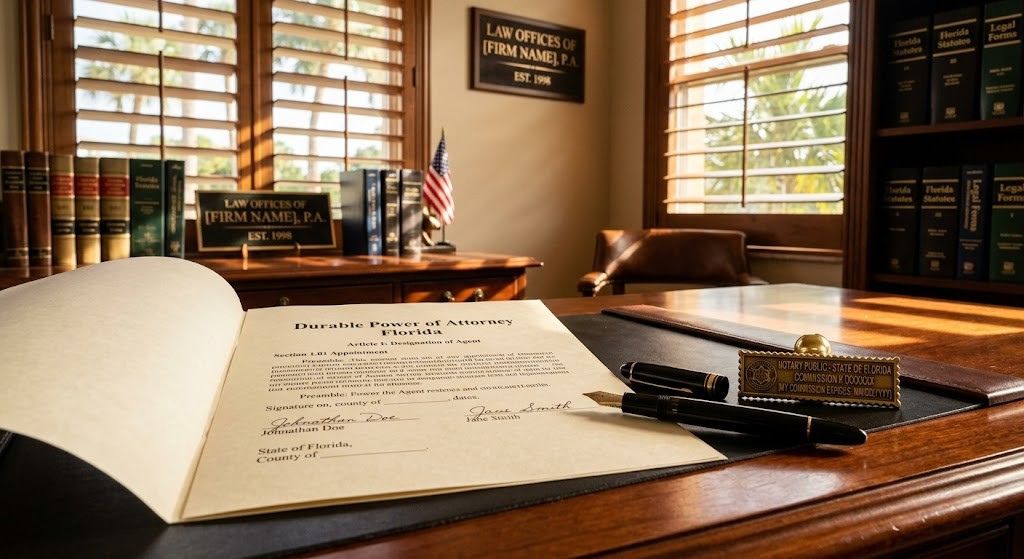
A Durable Power of Attorney Florida gives you a direct way to protect your finances if financial incapacity ever takes away your ability to sign, pay, sell, or manage accounts. Done correctly, it keeps your family out of guardianship court, which saves time, money, and a great deal of stress when life is already difficult.
What a Durable Power of Attorney Florida Is
A Durable Power of Attorney Florida is a legal document that lets you name a trusted agent to handle your financial and legal affairs if you become incapacitated. Think of it as a private planning tool that steps in before a judge does. That matters because guardianship is a court-controlled solution, and court control is exactly what most families want to avoid.
The practical value is simple. If you have the right document in place, your agent can keep bills paid, protect property, and deal with institutions without starting a guardianship case. That is the difference between planning ahead and letting a crisis drive the process.
Durable Means It Survives Incapacity
“Durable” has a very specific meaning under Florida law. It means the authority continues even after you lose capacity. Without that durability language, the document ends when incapacity begins, which defeats the entire purpose.
That is the trap many families miss. They sign a generic power of attorney, assume it is enough, and discover too late that it expired at the exact moment they needed it. Florida law does not reward loose drafting.
Principal, Agent, and Third Parties
You are the principal, the person creating the document. Your chosen decision-maker is the agent, sometimes called the attorney-in-fact. Banks, title companies, brokerages, and other institutions are third parties, and they are the ones that must honor the document if it is valid and properly presented.
That relationship matters because the document does not work in a vacuum. A well-drafted POA is only useful if third parties accept it without delay. That is why clear language and Florida-compliant execution matter so much in real life.
How a Durable Power of Attorney Florida Keeps Your Family Out of Guardianship Court
The core reason families create a Durable Power of Attorney Florida is to avoid guardianship court. Guardianship is a court remedy of last resort, used only when no less restrictive alternative is available. If a valid POA exists, the court should not need to step in just to manage finances.
That is the real planning advantage. A POA keeps decision-making private, fast, and family-centered. Guardianship does the opposite.
Guardianship Is Slower, Public, and More Expensive
Guardianship requires a petition, medical evidence, court review, and often ongoing supervision. It becomes part of the public record. It also adds attorney’s fees, court costs, reporting obligations, and repeated oversight.
Families feel that burden immediately. A home still needs insurance, bills still need payment, and accounts still need attention, but none of that waits for a court file to move. For a clear comparison of how the court process works, see Florida’s guardianship framework in Broward County.
A POA Lets Your Agent Act Without a Court Order
A valid POA gives your agent authority to act right away, without petitioning a judge first. That means your agent can handle banking, sign documents, pay expenses, and preserve assets during a medical emergency or long decline.
That speed is the point. Financial incapacity does not pause life, and a POA keeps the household functioning while everyone else focuses on care, recovery, or long-term planning.
What Happens When No Valid POA Exists
If incapacity arrives before planning is in place, or if the document fails Florida requirements, your family often has only one path left, guardianship. In a serious emergency, that can mean a rushed filing, temporary restrictions, and a court deciding who controls your property.
That is how avoidable problems become expensive ones. Once the crisis begins, the family is no longer choosing the best tool. The family is trying to salvage the situation before the court takes over.
Florida Law Requirements That Make or Break the Document
Florida is formalistic about powers of attorney. Intent is not enough. The document must comply with Chapter 709, or it can fail when your family needs it most. A sloppy form from the internet often looks fine until a bank, title company, or lawyer reads it closely.
The good news is that the rules are knowable. The bad news is that missing just one can make the whole instrument useless.
Two Witnesses and a Notary Are Required
Florida requires two subscribing witnesses and notarization for a valid durable power of attorney. Miss either requirement and the document is exposed to rejection and challenge.
This is not a box-checking detail. It is the foundation of enforceability. At Klein & Fortune, P.A., compliant execution is treated as part of the drafting process, not an afterthought, because that is how you build a document financial institutions honor.
Durability Language Must Be Included
The document must say that it remains effective despite incapacity. That single concept separates a durable POA from a regular power of attorney that dies with incapacity. No durability language means no continued authority.
That is why generic forms cause trouble. They often use vague wording, and vague wording creates exactly the kind of argument a bank uses to delay acceptance.
Florida No Longer Favors New Springing Powers
Florida generally does not allow new springing powers created after October 1, 2011, with limited exceptions. A springing power waits for a future event, usually a finding of incapacity, before it becomes effective. Modern Florida planning usually avoids that structure and uses an immediately effective durable POA instead.
That approach is cleaner in practice. If the document is meant to help during an emergency, it should already be ready to use. Waiting for a trigger only adds friction when time is already tight.
Florida-Specific Drafting Matters
Florida banks and title companies expect Florida-specific language and formatting. Out-of-state templates often miss the local details that matter most, especially for real estate authority and institutional acceptance.
If you own property, run a business, or manage multiple accounts, Florida-specific drafting is not optional. It is how you reduce the chance of rejection when the document actually has to work. This is where proactive incapacity planning for property and business owners becomes more than a slogan.
The Powers Your Agent May Need in a Real Emergency
A durable POA is only as useful as the powers inside it. In a real crisis, your agent needs practical authority, not broad language that sounds impressive but fails when used. The best documents match the way families actually live, spend, own property, and pay for care.
Banking, Bills, and Day-to-Day Money Management
Your agent should be able to handle deposits, withdrawals, bill payments, recurring expenses, and account administration. That keeps utilities on, insurance current, and taxes from falling behind.
It sounds basic because it is basic. But basic tasks become urgent the moment incapacity freezes access to your accounts. A good POA prevents a pileup of late notices and avoidable penalties.
Real Estate and Title Matters
Real estate authority matters enormously in Florida because homes are often the family’s largest asset. Your agent may need to insure property, sign closing documents, communicate with lenders, or sell a home if necessary for care planning.
That authority must be drafted carefully. Title companies look closely at whether the POA expressly allows the act at issue, especially for a sale or refinance. That is one reason Florida property owners benefit from a document built with title acceptance in mind, not just courtroom theory.
Investment and Asset Management
Your agent may also need authority over brokerage accounts, retirement coordination, and ordinary asset management. The goal is preservation, not speculation. Your family needs a document that prevents waste, missed deadlines, and frozen assets.
A well-drafted POA supports stable administration during financial incapacity. That stability matters whether the issue is a short hospital stay or a longer decline.
Medicaid and Long-Term Care Planning
Long-term care planning often depends on quick action. If nursing home costs, benefit applications, or asset protection steps become necessary, your agent needs enough authority to work through the process.
That does not mean your POA should be vague. It means it should anticipate the real tools families use before care costs consume savings. When Medicaid planning is in view, the language must be specific enough to support the strategy.
Powers That Require Special Express Authority
Florida treats certain powers as too important to hide in broad language. The document must expressly authorize them. That means a sentence buried in generalities does not do the job.
This is where many DIY forms fail. They give a false sense of security, then fall apart when a transaction demands precision.
Creating or Changing Trusts
If your agent may need to create or amend a trust, the POA must say so clearly. Trust authority is not assumed. Florida demands specific authorization because trust changes can reshape ownership and inheritance.
That distinction matters if your broader plan includes a Florida Revocable Living Trust. The POA and the trust serve different purposes, and the POA must be drafted to support the trust structure rather than accidentally collide with it.
Gifting and Asset Transfers
Gifting authority needs express language too. Without it, your agent cannot safely make transfers for tax planning, family support, or certain asset-protection strategies. The risk is self-dealing or unauthorized depletion of assets.
This is one area where precision protects everyone. If the power is intended, write it in. If it is not intended, leave it out. Ambiguity invites conflict.
Beneficiary and Survivorship Changes
Changing beneficiary forms, payable-on-death designations, or survivorship interests also requires explicit authority. These are not routine banking actions. They alter who receives property later, so Florida treats them with care.
That is why a POA should never be assembled from a generic checklist. The powers must match your actual estate plan and your actual assets.
Disclaimers and Other Advanced Powers
Disclaimers, election rights, and other advanced planning tools also need direct authority. If the document is meant to support a sophisticated estate plan, the drafting must anticipate those tools from the start.
This is not about making the POA longer for the sake of length. It is about making sure the document does something useful when a family faces a real legal problem.
What Your Agent Cannot Do
A POA is powerful, but it is not unlimited. Florida draws clear lines around personal acts and nondelegable rights. Knowing those limits keeps expectations realistic and prevents misuse.
Making a Will
Your agent cannot create or sign a will for you. A will remains your personal testamentary act. That rule is firm.
If estate distribution is the concern, the answer is proper estate planning, not expanding the POA beyond its legal role.
Voting and Other Personal Rights
Voting remains personal. Certain rights tied directly to your person cannot be handed off through a POA. Florida keeps those decisions where they belong.
That boundary protects autonomy. The agent steps in for financial administration, not identity-level choices.
Certain Personal Service Contracts
Some personal service contracts and highly personal obligations also stay outside the POA. If the task depends on your unique personal judgment or presence, the agent does not simply replace you.
That is why a POA is one part of a larger plan, not a substitute for every other document.
Why Florida Institutions Sometimes Reject a Power of Attorney
Even a valid POA can face resistance. Banks and other institutions review documents for validity, scope, and signs of abuse. If the paper looks old, unclear, or incomplete, acceptance problems start fast.
That is why drafting for real-world use matters as much as drafting for legal theory.
Good-Faith Refusal and Scrutiny
A financial institution can refuse to honor a POA in good faith if it questions the document’s validity or the agent’s authority. Institutions also worry about fraud and exploitation, so they examine the paperwork carefully.
The result is delay, sometimes at the worst possible moment. Families usually discover this during a crisis, not during a calm afternoon when there is time to fix the problem.
Why Old or Defective Forms Cause Trouble
Older forms are risky because Florida law changed significantly in 2011. Missing signatures, missing witnesses, missing durability language, and vague powers all create openings for refusal.
That same problem shows up with out-of-state templates. They may look polished, but they often fail Florida’s exact requirements. In a guardianship dispute, that failure can matter as much as a missing will, which is one reason people caught in a Contested Guardianship Florida case often discover the weakness too late.
How to Reduce the Risk of Refusal
Use Florida-compliant language, execute the document properly, and match the powers to the transactions you expect your agent to handle. Keep copies ready, make sure institutions receive the document early, and avoid vague or inconsistent provisions.
That is how a POA earns trust. Clear drafting reduces friction before anyone has a reason to say no.
Who You Should Choose as Agent
Choosing an agent is a judgment test. You need someone trustworthy, organized, available, and willing to follow your instructions under pressure. Family status alone does not qualify anyone.
Qualities of a Strong Agent
The best agent handles money responsibly, communicates clearly, and stays calm when decisions pile up. That person respects boundaries and documents transactions carefully.
You want someone who can think in systems, not emotions. That matters because financial incapacity often creates a blend of urgency, family stress, and paperwork that needs disciplined handling.
Why You Need an Alternate Agent
Always name a backup. The first choice may be unavailable, unwilling, or no longer the right person when the time comes.
That simple step prevents a gap in authority. A POA with no practical successor can create the same crisis you were trying to avoid.
When Family Conflict Makes Selection Critical
Blended families, sibling rivalries, and strained parent-child relationships turn poor drafting into open conflict. If the wrong person is named, the document becomes a battleground.
That is why selection and drafting belong together. A well-chosen agent reduces the chance that your loved ones end up fighting through a court process instead of handling the actual care issue. For families already dealing with aging parents, the pressure can resemble guardianship of elderly parents, which is exactly the outcome careful planning avoids.
How a Durable Power of Attorney Florida Fits Into a Complete Florida Estate Plan
A POA handles incapacity. It does not handle everything. For that reason, it should sit beside your other estate planning documents, each covering a different problem.
Pair It With a Health Care Surrogate and Living Will
Financial authority and health care authority are separate. A POA lets someone manage money and property. A health care surrogate and living will handle medical decisions and end-of-life instructions.
That separation is useful, not confusing. It gives the right person the right authority for the right issue. For a deeper look at medical decision tools, see how healthcare surrogates work in Florida and what living wills do at the end of life.
Pair It With a Will or Trust
A POA helps while you are alive and incapacitated. A will or trust controls what happens after death. If you mix those jobs together, mistakes follow.
That is also why probate avoidance and incapacity planning need to be coordinated. A strong POA supports the management side, while your will or trust handles estate administration after death.
Coordinate It With Property Ownership and Beneficiary Designations
Titles, beneficiary forms, and trust funding affect whether the POA can actually solve a problem. If your assets are titled incorrectly, the agent may face limits even with good paperwork.
That is the hidden issue many families miss. A clean estate plan is not just documents. It is documents plus ownership structure plus beneficiary alignment.
What Happens If Your POA Is Missing, Outdated, or Defective
When a POA is missing or flawed, the family loses speed and control. The crisis does not wait while everyone searches for a workaround. It moves straight toward court involvement.
Your Family May Need to Petition for Guardianship
If no valid alternative exists, a petition for guardianship becomes the fallback. At that point, the court decides capacity and appoints a guardian if the legal standard is met.
That is exactly what a POA is designed to prevent. When planning is absent, guardianship becomes the substitute.
Incapacity Creates Immediate Problems
A stroke, dementia diagnosis, traumatic injury, or sudden hospitalization can freeze access to property and accounts overnight. Bills still arrive. Care bills arrive even faster.
That is why incapacity planning is not a luxury for later. It is a practical safeguard against a very ordinary kind of crisis.
Problems Can Multiply Across Assets
One defective document can disrupt banking, real estate, insurance, and long-term care planning at the same time. The family ends up fixing one problem only to discover three more.
That kind of chain reaction is expensive. It also drains attention away from the person who needs care.
When You Should Review or Update Your Durable Power of Attorney
A POA is not a forever form. Review it when your life changes, your assets change, or Florida law changes. A stale document is a weak document.
After Marriage, Divorce, Birth, or Death
Major family events often change who should serve as agent and how authority should be structured. Divorce, remarriage, or the death of a chosen agent all justify a fresh review.
That review protects against old assumptions. A document should reflect your current family, not your former one.
After a Move or Change in Assets
New real estate, business interests, major account changes, or a move into a different legal and institutional environment all justify an update. The more your financial picture changes, the more your POA should be checked.
South Florida property owners face this constantly. Homes, rental property, and investment assets shift over time, and the document needs to keep up.
Every Few Years as Part of Proactive Planning
A periodic review keeps the document aligned with current law and current family circumstances. That habit prevents old forms from creating new trouble.
It also keeps your broader estate planning coordinated. A durable POA works best when it evolves with the rest of your plan.
Common Questions About a Florida Durable Power of Attorney
Does It Take Away Your Control While You Are Capable?
No. You remain in control while you have capacity, and the POA exists to protect you if incapacity disrupts your ability to act. It is a safety tool, not a surrender of ownership.
Can You Revoke It Later?
Yes, if you still have capacity. You can revoke a valid POA, and you should notify any institutions that rely on it so no one keeps using outdated authority.
Is a Florida POA Recognized Outside Florida?
Often yes, but recognition depends on the other state’s law and the institution’s policies. That is why Florida-compliant drafting matters even when you own assets beyond state lines.
Is Online DIY Planning Enough?
Not for a serious estate plan. Generic forms miss Florida’s execution rules, special authority requirements, and institutional acceptance issues. If your goal is to avoid guardianship and protect real assets, the document needs to be built correctly from the start.
What Is the Biggest Mistake Families Make?
Waiting until incapacity already exists. Once capacity is gone, the document cannot be fixed by signing a new one, and the family is pushed toward court instead of private planning.
Why Professional Drafting Matters in Broward and Miami-Dade County Planning
South Florida families deal with high-value homes, aging parents, adult children stepping in, and real pressure to preserve autonomy. That combination makes precision matter. A sloppy form can create more trouble than having no plan at all.
Local Families Face High Stakes With Homes and Assets
In Hollywood, Pembroke Pines, Fort Lauderdale, and across Broward and Miami-Dade County, real estate and family wealth are often tied together. When incapacity hits, the stakes are not abstract.
That is why careful planning matters for property owners as much as for retirees. A document that works on paper but fails at the bank helps no one.
Precise Drafting Protects You From Court and Delay
Klein & Fortune, P.A. structures instruments with Florida execution rules, institutional acceptance, and real-world use in mind. That means durable language, clean authority grants, proper witnesses, notarization, and tailored powers for the transactions that actually arise.
That level of care keeps families out of guardianship court whenever possible. It also reduces the risk of a rejected document at the exact moment timing matters most.
The Right Plan Saves Time, Money, and Stress
A properly drafted POA lowers friction, preserves privacy, and gives your family a clear path during financial incapacity. It is one of the most efficient estate administration tools you can put in place before a crisis starts.
Understand the document before you need it. That is the difference between a calm handoff and a court case.
Frequently Asked Questions
How does a Florida durable power of attorney prevent guardianship?
It gives your chosen agent authority to manage finances and legal affairs without asking a judge first. If the document is valid and broad enough for the task, guardianship usually becomes unnecessary.
What makes a durable power of attorney invalid in Florida?
Missing durability language, missing witnesses, missing notarization, or failing to give specific authority for certain acts can all create serious problems. Florida requires precision.
Can my agent sell my home under a Durable Power of Attorney Florida?
Yes, if the document expressly authorizes real estate transactions. A vague POA often creates title problems, so the wording must be clear.
Does a durable power of attorney cover medical decisions?
No. Financial authority and health care authority are separate. You need a health care surrogate and living will for medical decisions.
Can a bank refuse to honor my power of attorney?
Yes, if the bank believes the document is invalid, outdated, or too unclear, or if it sees possible abuse. Proper drafting and execution reduce that risk significantly.
Should I use a Florida lawyer instead of an online form?
Yes. Florida law is strict, and a defective form can force your family into guardianship court. Proper drafting is cheaper than fixing a failure during a crisis.
A Durable Power of Attorney Florida works only when it is drafted with the right authority, executed correctly, and coordinated with the rest of your estate plan. Get that part right, and your family keeps control where it belongs, outside guardianship court.