
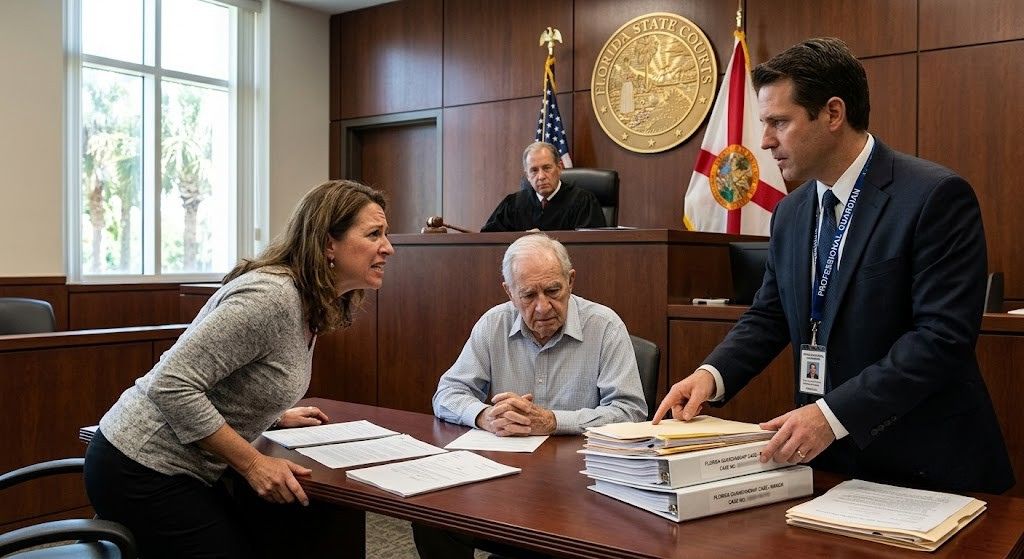
A contested guardianship Florida case is a fight over control, rights, and money, all at once. You are not just arguing about paperwork, you are arguing about whether a court should take away decision-making power, who should hold that power, and how far it should reach.
That is why these cases escalate fast. Once incapacity, family conflict, or asset concerns enter the picture, the dispute becomes family litigation with real courtroom consequences, not a private disagreement at the kitchen table.
What a Contested Guardianship Florida Case Means
A contested guardianship Florida case is a court fight over whether a guardian is needed, who should serve, and how much authority that person should have. Under Florida law, guardianship is a last resort, because the process strips legal rights from the person placed under it.
That is the real pressure point. If the court appoints a guardian, your autonomy changes immediately, along with control over finances, medical decisions, and sometimes where you live. For a clear overview of the statutory framework, see Florida Guardianship Laws.
Guardianship Versus Less Restrictive Alternatives
Florida courts do not jump to guardianship first. They must look for a less restrictive alternative, such as a durable power of attorney, trust, health care surrogate, or proxy, before imposing court control. That rule drives many court disputes because the fight often centers on whether planning already exists.
In practice, this is where a case turns. If you have strong advance planning in place, the petition for guardianship loses force. If you do not, the court has a much easier path to intervention. The difference between Guardianship vs Power of Attorney is often the difference between private control and court supervision.
Who Becomes a Ward and Why That Matters
Once the court adjudicates incapacity, the person becomes a ward. That label matters because the legal stakes change immediately, and family members lose control over major decisions unless the court preserves certain rights.
Florida also recognizes voluntary guardianship for a competent adult who asks for help managing an estate, and involuntary guardianship when the court finds incapacity. Either way, the result is the same basic structure, a court-supervised decision-maker replaces personal control.
Why Families Fight Over Guardianship
Families fight over guardianship because the case touches everything people already disagree about, money, care, control, and trust. If a parent’s health declines or a vulnerable adult becomes isolated, old resentments surface fast and every transaction starts to look suspicious.
These disputes are also personal in a way most civil cases are not. You are not just choosing a fiduciary, you are deciding who gets authority over a parent, spouse, or adult child. That is why Guardianship of Elderly Parents often turns into a broader family confrontation.
Disputes Over Capacity and Incapacity
Capacity is the center of the case. Florida courts rely on examining committee members, medical evidence, and testimony to decide whether the person lacks capacity to handle some or all decisions. In a contested case, every medical note and witness statement becomes evidence.
Florida’s framework often uses three examining committee members, and if two of the three find incapacity, the court can move toward adjudication. That is why these hearings feel so intense, because the entire case can turn on a narrow evidentiary record and a judge’s view of credibility. If the medical issue is urgent, Emergency Temporary Guardianship can become part of the fight.
Conflicts Over Who Should Serve as Guardian
Even when everyone agrees that help is needed, families still fight over who should serve. Adult children disagree, relatives accuse each other of self-interest, and the court may also consider a professional guardian or public guardian when family trust has broken down.
Florida allows a qualified adult resident, a corporation, or a professional guardian to serve, but the judge still reviews fitness, conflicts, and prior conduct. If one proposed guardian has a history of financial control or hostility, that person loses credibility fast.
Allegations of Undue Influence, Exploitation, or Misuse of Assets
Money changes everything. Sudden transfers, new beneficiaries, isolated communication, or changes to estate documents often trigger allegations of undue influence or exploitation. Once those accusations are on the table, the case usually expands into a deeper records fight.
That is where trial skill matters. A lawyer handling contested guardianship Florida litigation must know how to use bank records, phone records, witness testimony, and estate planning documents together, especially when the dispute overlaps with trusts or real estate. Klein & Fortune’s experience in trust disputes and property litigation matters because these cases rarely stay in one lane.
How Florida Courts Handle a Contested Guardianship
Florida guardianship cases move through a structured process, but contested matters are still litigation. You start with a petition, then objections, hearings, discovery, and a judicial ruling on whether guardianship is necessary and how broad it should be.
In Broward and Miami-Dade County, that process moves through crowded probate dockets, so timing matters. If you want the procedural roadmap, Florida Guardianship Process shows how these cases develop in South Florida courts.
Filing the Petition and Triggering the Case
The petition starts the case and frames the dispute. In a voluntary matter, the adult asks for help. In an involuntary case, someone else asks the court to step in because incapacity is alleged.
That filing forces the issue into court, even if family members wanted to keep things informal. Once the petition lands, everyone’s position becomes visible, and the case starts building toward a hearing.
Objections, Hearings, and Evidence
Contested guardianships are evidence-heavy. You see motions, depositions, subpoenas, and testimony from doctors, relatives, caregivers, and financial witnesses. The key is not loud accusations, it is proof.
That is also where procedural mistakes get expensive. If records are missing or witnesses are not prepared, the court fills in the blanks with whatever evidence it trusts most. A strategic lawyer keeps the focus on capacity, assets, and decision-making, not family drama.
Court Review and Guardian Appointment
The judge decides whether guardianship is necessary, whether it should be limited or plenary, and who should be appointed. Florida prefers the least restrictive result, so the court removes only the rights it finds must be removed.
That decision carries due process consequences. Once the court acts, the ward loses real autonomy, so judges are supposed to examine the evidence carefully. If the fight is about future planning rather than emergency protection, Incapacity Planning Strategies often matter more than a courtroom battle.
What Florida Law Requires in a Contested Case
Florida law does not treat guardianship like a simple family preference. Chapter 744, Florida Statutes, and the Florida Probate Rules control the process, the proof, and the court’s authority.
Limited Guardianship Versus Plenary Guardianship
Limited guardianship removes only certain rights. Plenary guardianship removes all delegable rights after a finding of incapacity. Florida prefers the limited route whenever the evidence supports it.
That distinction is not academic. A limited guardianship protects more autonomy, while a plenary guardianship gives the guardian much broader control over daily life and property.
Expressed Wishes and Court-Appointed Counsel
Florida law requires court-appointed counsel to advocate for the person’s expressed wishes. That rule matters because the lawyer does not get to substitute personal judgment for the client’s own position.
The point is simple. If the person says no guardianship, counsel must press that position, even if everyone else thinks a guardian is a better idea. That rule has real force in contested hearings.
Removal or Oversight of a Guardian
A guardian remains under court supervision and can be removed for abuse, neglect, or misconduct. That oversight gives families a remedy when a guardian oversteps or misuses authority.
If the guardian starts acting like an owner instead of a fiduciary, the court can intervene. That is one reason a court-appointed guardian must be monitored closely after appointment.
How You Resolve the Dispute Without Losing More Time and Money
The best strategy is to build the case around evidence, not emotion. Medical records, financial documents, witness testimony, and planning documents create leverage. Family accusations alone do not.
The second strategy is to avoid creating the dispute in the first place. A properly drafted Designation of Healthcare Surrogate, a durable power of attorney, a trust, and a Pre-Need Guardian Designation can reduce the chance that a court has to step in later.
Build the Case Around Evidence, Not Emotion
Judges in crowded probate divisions need clear proof. That means organized records, a timeline, and a direct theory of why guardianship is or is not necessary.
In a contested case, that discipline wins more often than outrage does. It also helps you control cost, because every stray issue you let into the case becomes another fight.
Use Proactive Planning to Avoid Future Guardianship Battles
If you own real estate, manage family assets, or run a business, advance planning is not optional. A trust, power of attorney, and health care documents preserve control while you are still able to choose.
That is how you keep family litigation from becoming court-ordered supervision. Living Wills Florida and a Florida Revocable Living Trust work best when they are in place before the crisis.
Consider Court Congestion, Delay, and Cost Before Escalating
South Florida probate courts carry heavy caseloads, and contested matters consume time fast. In Broward and Miami-Dade, a guardianship fight can take months and cost tens of thousands of dollars or more.
That reality matters because delay itself becomes leverage. The longer the case drags on, the more stress, expense, and family damage you absorb.
Why Strong Legal Guidance Matters in South Florida
Contested guardianship Florida litigation requires more than familiarity with probate forms. You need counsel who can handle evidence, understand court pressure, and protect assets when the dispute overlaps with trusts or real estate.
That is where trial readiness matters. If the fight touches deeds, title issues, or family property, the same discipline that wins real estate cases also strengthens guardianship strategy.
Protecting Family Assets and Personal Autonomy
The end goal is not just to win a motion. The end goal is to preserve autonomy where possible, limit intrusion where necessary, and keep assets from being swallowed by unnecessary court control.
If you understand that principle early, you make better decisions. You plan differently, document better, and push back sooner when a petition overreaches.
When You Need Immediate Help
If a petition is pending, assets are moving, or a family member is being isolated, act immediately. Early intervention protects rights, narrows issues, and gives you a stronger position before the court locks in a result.
Frequently Asked Questions
What makes a guardianship “contested” in Florida?
A guardianship becomes contested when someone challenges the need for guardianship, the scope of authority, or the proposed guardian’s fitness.
Can a guardianship be limited instead of full?
Yes. Florida law prefers limited guardianship when the person retains some decision-making capacity.
Who can be appointed guardian in Florida?
A qualified adult resident, a corporation, a professional guardian, or a public guardian can serve if the court finds the person fit.
Can the court ignore a power of attorney?
No. The court must consider whether a durable power of attorney or another less restrictive tool already addresses the problem.
Can a guardian be removed later?
Yes. A guardian can be removed for abuse, neglect, misconduct, or failure to act properly under court supervision.
Why do contested cases cost so much?
They require hearings, records, expert evidence, and motion practice, and they often drag on for months while family conflict continues.
References
- caselaw.findlaw.com
- flcourts.gov
- flprobatelitigation.com
- flprobatelitigation.com
- ginsbergshulman.com
- ginsbergshulman.com
- pew.org
- porterwright.com