
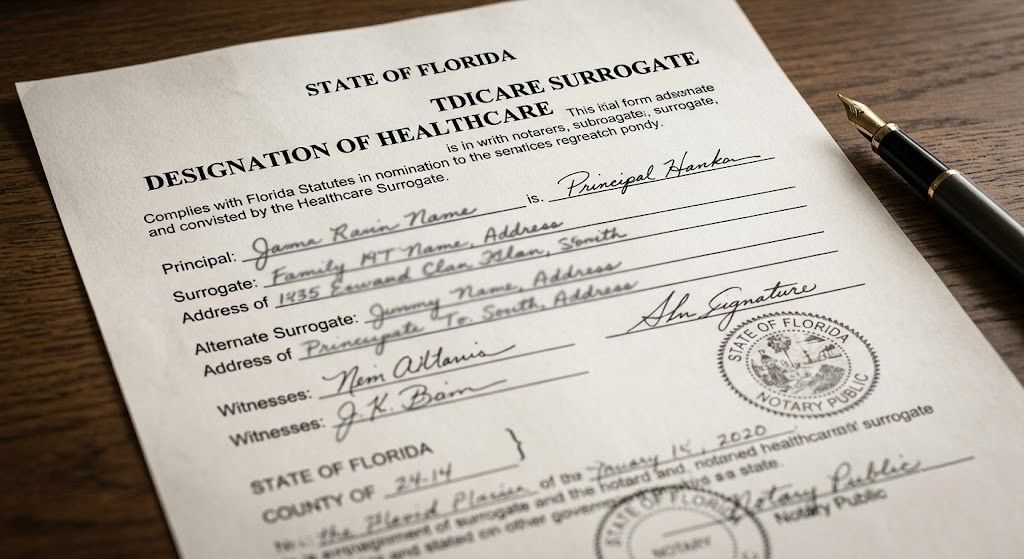
A Designation of Healthcare Surrogate is the document that names who speaks for your medical care when you cannot speak for yourself. If you wait until a hospital corridor, an ICU, or a family crisis to sort that out, you give away control at the exact moment control matters most.
Why a Designation of Healthcare Surrogate Matters Before a Medical Crisis
A Designation of Healthcare Surrogate is a legal advance directive that puts a trusted person in charge of communicating with doctors and making healthcare decisions when you lose capacity. That is the whole point. It keeps your medical care tied to your wishes instead of leaving hospitals, relatives, or a court to guess what you would want.
In South Florida hospitals, that distinction matters fast. Admissions teams need clear authority, physicians need a decision-maker who can answer questions, and family members need a legal plan before emotions take over. Without that document, delays start piling up, and every hour of uncertainty adds pressure to an already serious situation. For a broader look at how this fits into the legal side of planning, see guardianship alternatives that avoid court control.
A lot of people think this document is only for end-of-life care. That is wrong. It matters for strokes, car accidents, anesthesia, dementia, serious infection, and medication-related confusion. It matters any time you are alive but unable to communicate clearly enough to direct your own treatment.
What a Healthcare Surrogate Does
A healthcare surrogate does far more than relay messages. The surrogate can review records, speak with physicians, authorize tests, consent to surgery, and approve or refuse treatment, including life support, if your documents and circumstances authorize that authority. Think of the role as a legal voice that steps in when your own voice disappears.
That authority protects your medical wishes when communication breaks down. If you are sedated, unconscious, confused, or otherwise incapacitated, a surrogate keeps care moving in the direction you already chose. That is why clear medical directives matter so much. They turn your values into instructions that a decision-maker can actually use.
Why Medical Emergencies Expose the Problem
Emergencies do not wait for family meetings. A stroke can take away speech in minutes. A fall can lead to anesthesia, surgery, and a foggy recovery. Dementia can slowly erase decision-making ability. Severe illness can leave you too weak, too confused, or too medicated to answer basic questions.
That timing is the problem. Families rarely have time to negotiate who should speak for you while a doctor is waiting for consent. A hospital cannot run on assumptions, and adult children often disagree when no one has been named. The legal mess that follows is exactly what advance planning is supposed to prevent.
How a Designation of Healthcare Surrogate Protects Your Autonomy
This document protects your autonomy because you choose who makes decisions for you before a crisis strips away your ability to choose in the moment. Your preferences stay at the center of care, even when you cannot personally speak to the team treating you.
That matters in Florida elder law because incapacity planning is not just about assets. It is about dignity, control, and minimizing the chance that a stranger or a strained family dynamic steers your treatment. At Klein & Fortune, P.A., this is the kind of planning that prevents confusion before it becomes a legal problem.
You Decide Who Speaks for You
You control the appointment. Not the hospital. Not the court. Not a default family hierarchy based on birth order or who yells the loudest. That is one reason this document is so powerful.
The best surrogate is not automatically your spouse, oldest child, or closest relative. It is the person who will follow your instructions, stay calm under pressure, and act quickly when time matters. If your family dynamics are complicated, that is exactly when a formal appointment matters most.
Your Wishes Guide the Decision-Maker
A surrogate is not there to invent a treatment plan from scratch. The surrogate is there to carry out your known wishes, your values, and your advance instructions. If you have already explained what matters to you, the decision-maker has a clear path to follow.
That reduces guesswork and prevents unwanted treatment. It also helps doctors move with confidence because they are not relying on vague family opinions. For many families, that is the difference between a clean decision and a fight that never should have happened.
What Happens If You Do Not Name a Surrogate
If you do nothing, someone else still has to make the call. That is where confusion starts, and confusion in a medical setting is expensive, stressful, and dangerous. Treatment gets delayed, family members argue, and doctors are left without a clear legal decision-maker.
In serious disputes, the process can slide toward guardianship, which brings a judge into your medical life. If you want to see how ugly those fights become, look at high-stakes disputes in contested guardianship cases. Once court involvement starts, your family loses speed, privacy, and control.
Family Members May Disagree
Adult children do not always agree with each other. Spouses and children do not always see eye to eye. A relative who has not been involved in day-to-day care may suddenly show up with strong opinions and no legal authority. That is a recipe for conflict.
The emotional cost is obvious, but the practical cost is worse. Doctors need answers. Tests are waiting. Decisions about surgery, medication, or discharge planning cannot stall while relatives debate who should be in charge. A properly executed surrogate designation cuts that conflict off early.
A Court May End Up Controlling the Process
When no valid surrogate exists, court involvement can become necessary. That is how medical decision-making drifts into the guardianship system, where a judge decides who has authority and what limits apply. If you want a sense of that process, review what an incapacity hearing looks like in Florida.
Court oversight is slow compared to a signed advance directive. It also adds cost, public exposure, and uncertainty. In urgent situations, families do not need another hearing. They need a valid document that already speaks for the person who cannot speak.
When the Designation Takes Effect
The designation takes effect when you cannot make or communicate healthcare decisions yourself, which usually means incapacity or another condition that leaves you unable to act. In practice, that can happen suddenly after an accident or gradually as a disease progresses.
Some situations allow a surrogate to be named before full incapacity becomes obvious, which is useful before surgery, during recovery, or while medication affects communication. That flexibility matters because incapacity planning is often easier before a crisis than during one.
Incapacity Is Not Limited to End-of-Life Care
People hear “medical surrogate” and assume hospice. That assumption is too narrow. A temporary loss of speech after a stroke, confusion after anesthesia, or medication side effects after surgery all create the same legal problem, you cannot speak for yourself when decisions must be made.
Dementia is another obvious example, but it is not the only one. Serious infection, head trauma, or a prolonged ICU stay can do the same thing. The document matters because incapacity is not a rare, end-of-life event. It is a real possibility in ordinary adult life.
You Can Plan Before a Crisis Starts
Planning early is the safest move. When you complete the document while you are healthy, your intentions are clear, your signature is valid, and no one can argue that pressure shaped your choice. That is exactly why families across Broward and Miami-Dade County should treat this as routine legal planning, not an emergency chore.
The research supports that approach. In one study of 3,746 adults age 60 and older who died between 2000 and 2006, 42.5% needed decision-making near the end of life, and 70.3% of those lacked decision-making capacity. Advance directives were present in 67.6% of those lacking capacity, and documented preferences tracked closely with the care actually received (NEJM study). That is the payoff of planning before the crisis.
How to Choose the Right Healthcare Surrogate
Choosing the right person matters more than signing the paper. You need someone who will follow instructions, speak clearly under stress, and stay available when a hospital needs an answer now, not later.
That means judging character, not title. Trust, availability, and decisiveness beat family politics every time.
Choose Trust Over Family Title
Do not choose based on who is “supposed” to do it. Choose the person who respects your boundaries, keeps information private, and does not fold under pressure from other relatives. A calm adult child who listens may be a far better choice than a spouse who refuses to confront hard medical decisions.
AARP’s guidance aligns with that practical approach, emphasizing proximity, trustworthiness, mental and physical ability, advocacy, and willingness to serve. That is the right framework. The surrogate has to show up, understand the stakes, and act when emotions are running hot.
Evaluate Availability and Advocacy
Your surrogate should be reachable quickly and willing to go to the hospital, speak to doctors, and follow through. Geographic proximity helps, but reliability matters more. A person who lives nearby but avoids hard conversations is a weak choice.
You are not looking for popularity. You are looking for someone who can say yes when the answer needs to be yes and no when treatment conflicts with your wishes. That is especially important in urgent healthcare decision-making protocols used by South Florida hospitals, where discharge planning and treatment authorization often move fast.
Name an Alternate Surrogate
Always name a backup. Your first choice may be out of town, hospitalized, overwhelmed, or simply unreachable. An alternate keeps your plan alive instead of forcing a fresh debate at the worst possible time.
Florida Requirements for a Valid Designation
Florida law requires proper execution for the document to work when it matters. The principal must sign, two adult witnesses must sign, at least one witness cannot be the spouse or a blood relative, and the surrogate cannot serve as a witness. Those formalities are not decoration. They protect validity.
Signature and Witness Rules
The signature and witness rules are straightforward, but they matter. If the document is not signed correctly, or if the wrong people witness it, the paperwork can fail when a hospital reviews it. That creates avoidable delay and invites challenge.
Why Proper Execution Matters
A flawed form is a weak form. When the medical team needs legal certainty, any defect becomes a problem. You do not want a hospital lawyer, a nurse, or a family member arguing about whether the document is enforceable while a decision is waiting.
That is why precision matters. Good legal drafting and correct signing eliminate nonsense later.
Revocation and Updates
You can revoke or replace the designation at any time. That flexibility matters after divorce, remarriage, a death in the family, a move, or a change in health. A document that still names the wrong person is worse than useless, because it creates false confidence.
How This Document Works With Other Advance Directives
A healthcare surrogate designation is one piece of a larger plan. It works alongside a living will, do-not-resuscitate instructions, and other medical directives to create a complete picture of your wishes. For a clear comparison, see how living wills fit into end-of-life planning.
The distinction matters. A living will says what treatment you want or do not want. The surrogate document names who enforces those wishes. That is why a complete plan needs both.
Living Will vs. Healthcare Surrogate
A living will speaks for your preferences in advance. A healthcare surrogate speaks for you in real time. One is the instruction, the other is the messenger and decision-maker.
If you only have one, your plan is incomplete. A living will without a surrogate can leave your family arguing over interpretation. A surrogate without clear treatment instructions may have too much room to guess. Pairing the two removes ambiguity.
Health Care Surrogate vs. Financial Power of Attorney
Medical authority and financial authority are separate. A financial power of attorney handles money, bills, and property matters. A healthcare surrogate handles treatment decisions and communication with providers. Those jobs do not merge just because one person is trustworthy.
That separation is especially important for families managing real estate, accounts, and long-term planning. If incapacity threatens both medical and financial control, you need a plan that covers each lane correctly. That is where durable authority for finances and incapacity planning for property owners become part of the same strategy.
Common Misunderstandings That Leave Families Unprotected
The biggest mistake is assuming someone else will handle it. Hospitals do not work on assumptions, and family relationships do not create legal authority by themselves. If you want your preferences followed, you need paperwork that says so.
“My Spouse Will Automatically Decide”
That belief causes avoidable problems. A spouse often does have priority in practice, but hospitals still want clear legal direction. If the relationship is strained, separated, or contested, assumptions become dangerous fast.
“I Am Too Young to Need This”
Age is not the trigger. Adulthood is. A car accident, a surgery complication, pregnancy-related emergency care, or sudden illness can leave any adult unable to speak for a period of time.
“I Can Wait Until I Am Sick”
That is the worst time to act. Once capacity is in question, the legal and medical process gets harder. If you are already confused, sedated, or in crisis, you may not be able to complete the document at all.
Why Families in Florida Benefit From Early Planning
Early planning protects family harmony and keeps medical care moving. It also reduces the odds of court involvement, which is exactly what families want to avoid when a crisis hits. A valid designation is cleaner than a fight, faster than a petition, and more respectful of your autonomy.
In Florida elder law, this kind of planning sits beside other protections like pre-need guardian designations, court alternatives for incapacity planning, and, when needed, the legal framework for Florida guardianship law in Broward County. The point is simple, use planning to keep courts out unless there is no other path.
Protecting Family Harmony
A written designation cuts down on guilt, second-guessing, and power struggles. Family members still need to talk, but the conversation starts with your decision, not theirs. That changes the tone immediately.
Avoiding Delay in Urgent Care
Doctors move faster when the legal decision-maker is already identified. Treatment plans, consents, and discharge decisions all happen with less friction. In a medical emergency, less friction is not a luxury. It is protection.
Preserving Long-Term Control
Once you understand how the designation works, the strategy becomes obvious. You keep control by choosing in advance, and you preserve that control by keeping the document current and accessible. That is the difference between directing your care and leaving others to improvise.
How to Put the Right Plan in Place Now
Start with the person you want in charge, then put your wishes into writing and execute the document correctly. Do not bury the form in a drawer. Put copies where your doctors, your surrogate, and your family can find them fast.
Klein & Fortune, P.A. helps families draft explicit medical surrogacy documents that fit the reality of Florida hospitals and the realities of family life. That means precise language, clean execution, and a plan that matches your broader estate and incapacity strategy.
Talk Through Your Wishes First
Have the hard conversation before signing anything. Tell your chosen surrogate what matters to you, what treatment boundaries you want, and what decisions you refuse to leave to chance. A document works better when the person named inside already understands the job.
Complete and Store the Document Properly
Sign it with the correct witnesses. Give copies to your primary physician, your surrogate, and your alternate. Keep a copy with your other medical directives so no one has to search for it during a crisis.
Review the Plan After Major Life Changes
Update the document after marriage, divorce, death, diagnosis, a move, or a major shift in family relationships. A stale plan creates the same problem as no plan at all, it leaves the wrong person in charge.
Frequently Asked Questions
What is a Designation of Healthcare Surrogate?
It is a legal document that names a person to make medical decisions and speak with healthcare providers if you cannot do so yourself. In Florida, it is a core part of advance care planning.
Can my surrogate make life support decisions?
Yes, if your document and circumstances authorize that authority. The surrogate must still follow your known wishes and any written medical directives you already set out.
Does my spouse automatically become my surrogate?
No automatic assumption protects you. A spouse may be the obvious choice, but hospitals want clear legal authority, especially if family conflict, separation, or uncertainty exists.
Can I change my surrogate later?
Yes. You can revoke or replace the designation whenever you want, as long as you do it properly. Update it after major life changes so the document matches your current wishes.
Do I need both a living will and a healthcare surrogate?
Yes, if you want a complete plan. The living will states your preferences, while the surrogate carries them out and makes decisions when doctors need immediate answers.
What happens if I never sign one?
Your family may face delay, conflict, or court involvement. In serious cases, a judge may have to appoint someone, which puts your care on a slower and less personal track.
Why You Should Act Before a Medical Emergency Forces the Issue
You protect your autonomy by deciding now who speaks for you later. That single decision keeps your care aligned with your values, reduces conflict, and gives doctors the authority they need without forcing your family into a crisis-driven guessing game. In practice, that is what real planning looks like, clear, signed, and ready before anyone needs it.
References
- aarp.org
- journals.sagepub.com
- nber.org
- nejm.org
- pmc.ncbi.nlm.nih.gov
- umiamihealth.org
- virtuallawoffice.com