
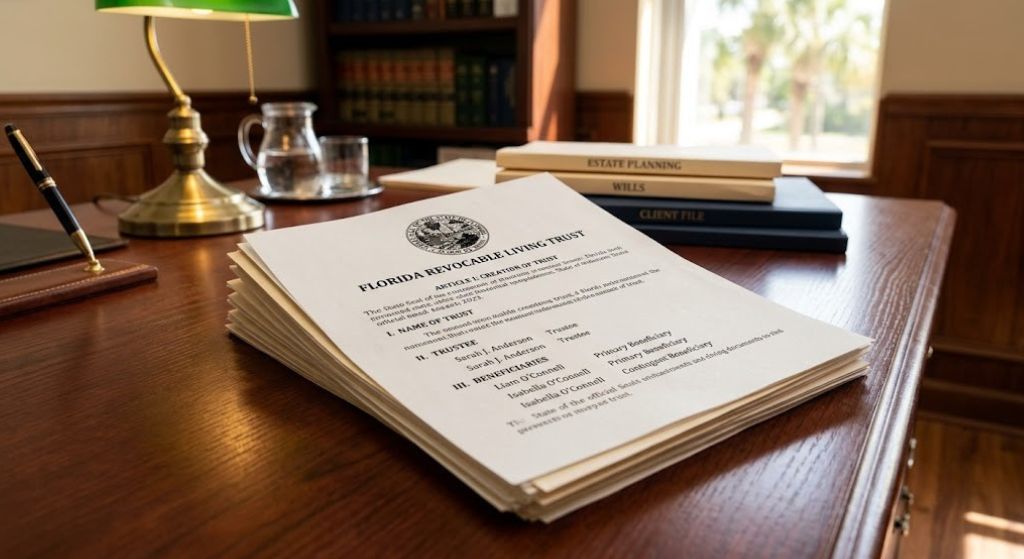
A Florida Revocable Living Trust gives you a practical way to manage property during life and keep control moving smoothly if incapacity hits. The real value is simple: your assets stay under a plan you already chose, instead of landing in a court-controlled guardianship process when a crisis leaves your family scrambling.
What a Florida Revocable Living Trust Is
A Florida Revocable Living Trust is a legal arrangement you create to hold title to your assets while you are alive, with you usually serving as your own trustee and beneficiary. In plain English, you put a structure in place that says, “These assets are managed under these rules,” and you name a successor trustee to step in if you become unable to act. That makes the trust a control document, not a surrender document.
The point is not to give up your property. The point is to keep management organized, private, and ready for the exact moment your own decision-making stops.
How the Trust Works During Your Lifetime
During your lifetime, you usually keep full practical control. You can sell the house, move money, refinance property, and change beneficiaries if the trust terms allow it, as long as you remain competent. The trust holds legal title to the assets you transfer into it, while you continue to use and benefit from those assets.
Think of it like putting your property into a well-labeled filing system. The system owns the paperwork, but you still direct the activity while you are in charge. Once incapacity arrives, the filing system does not collapse, it already has a backup manager.
Why “Revocable” Matters
“Revocable” means you can amend or cancel the trust while you have legal capacity. That flexibility matters because your plan should adapt as your family, assets, and goals change. If you buy a new home in Broward County, open a new account, or shift your distribution plan, you revise the trust instead of being trapped by it.
That is the main reason a Florida Revocable Living Trust fits real life. You keep control now, and you build continuity later.
Why Incapacity Court Becomes a Problem
Without a trust structure in place, incapacity pushes your family toward court supervision. If you cannot manage your money or property and no valid system already exists to carry that authority, someone usually has to ask a judge for permission to step in. That process is formal, public, and slow.
Florida is not gentle about this. Probate and guardianship proceedings consume time, money, and emotional energy, which is exactly when your family has the least of all three.
What Court-Controlled Guardianship or Conservatorship Does
A court-controlled guardianship places a judge in the middle of your financial life. The court decides whether you need a guardian, who that guardian should be, and how much authority that person receives. For a full explanation of the court side of the process, see how Florida court intervention works and what happens when capacity is challenged.
Once the court gets involved, the guardian does not simply “help out.” The guardian operates under judicial oversight, often with reports, accountings, approvals, and limitations. That structure exists for protection, but it removes speed and privacy from the equation.
Why Families Try to Avoid That Process
Families avoid guardianship because it delays action exactly when bills still need paying and property still needs protection. A mortgage does not pause for a court hearing. Insurance premiums do not wait for a petition to be filed. And if you own Florida real estate, delay creates real risk.
The process also strips away privacy. Court filings become part of the public record, so your family’s financial affairs are no longer handled behind closed doors. That loss of autonomy is why thoughtful planning matters long before a crisis starts. If you want a deeper look at the difference between private planning and court control, the tradeoffs between guardianship and power of attorney make the contrast clear.
How a Florida Revocable Living Trust Avoids Incapacity Court
Here is the core advantage: a properly funded trust already names the person who steps in. The successor trustee does not need to ask a judge for permission to manage trust-owned assets. The trust document itself creates the authority.
That structure prevents your family from starting from zero. Instead of proving to a court that you are incapable and then waiting for a judicial order, your successor trustee follows the instructions you already set.
Successor Trustee Authority
Your successor trustee takes over administration when incapacity is established under the trust terms. That means the person you selected can collect information, contact institutions, manage trust property, pay trust expenses, and preserve the assets for your benefit. The transition is built into the plan, which is exactly what makes it effective.
This is where proactive incapacity planning for property owners pays off. A successor trustee is not a placeholder. It is the person who keeps the entire structure alive without court delay. If your trust is drafted correctly, the transition feels administrative, not dramatic.
Continuity for Bills, Investments, and Real Estate
A successor trustee can keep the practical pieces moving. That includes mortgage payments, utilities, property taxes, insurance premiums, account oversight, and rental income collection. If you own a condo in Fort Lauderdale, a home in Pembroke Pines, or investment property anywhere in South Florida, continuity matters more than theory.
The real value shows up in ordinary tasks. Bills get paid. Mail gets opened. Maintenance continues. Assets stay protected. That is what incapacity asset management is supposed to do, and the trust handles it without forcing your family into emergency court proceedings.
Why the Trust Structure Is Stronger Than Waiting for a Court Order
A court order comes after a problem. A trust comes before it. That difference changes everything, because your family already knows who is in charge, what the authority covers, and how assets are supposed to be managed.
Waiting for a judge creates delay and uncertainty. The trust removes both. A properly drafted Florida Revocable Living Trust gives your family a private chain of authority, which is far better than asking a court to improvise a solution under stress.
What Assets Belong in the Trust
A trust only works for the assets that are actually titled into it or otherwise coordinated with it. That is where many families lose the benefit. The document alone does not manage anything. The asset must be aligned with the plan.
Real Estate in Florida
Florida real estate is the easiest place to start because property ownership is visible and easy to retitle. Homes, vacation properties, and rental property are common trust assets, especially when avoiding probate on Florida real estate is part of the goal. A trust can help keep the title clean and the transition private.
For families with local homes and investment properties, this is where a boutique firm’s real estate and trust experience matters. A deed must be handled correctly, and the trust language must fit the property strategy. At Klein & Fortune, P.A., that coordination is where legal precision saves real-world headaches.
Bank and Brokerage Accounts
Bank and brokerage accounts often belong in the trust plan because they are the accounts most likely to need active management during incapacity. If the successor trustee controls those accounts, bills can be paid and investments can be monitored without a court stepping in.
This is also where bad funding habits show up. An account left in your individual name sits outside the trust and may force court involvement later. The account titled to the trust stays inside the management structure you created.
Personal Property and Other Titled Assets
Personal property needs more careful thinking. Valuable collectibles, artwork, business interests, and certain titled assets may require separate documentation or transfer steps. Vehicles also deserve special attention because title rules and insurance issues differ from property to property.
The fix is not complicated, but it must be intentional. Trust planning works best when each asset is reviewed with the same question: who controls this if you cannot?
What Assets Usually Stay Outside the Trust
Not every asset belongs in the trust, and forcing the wrong assets into it creates new problems. Good planning is selective. It coordinates the trust with the rest of your estate plan instead of stuffing everything into one document.
Retirement Accounts
IRAs, 401(k)s, and similar retirement accounts usually should not be retitled into a revocable trust. That can create tax trouble and interfere with beneficiary designations. The account owner should coordinate beneficiary forms carefully rather than moving the account into trust ownership.
The better approach is deliberate planning, not reflexive transfer. Retirement accounts follow rules that differ from bank accounts and real estate, so the paperwork needs to respect those rules.
Assets With Beneficiary Designations
Life insurance, payable-on-death accounts, transfer-on-death accounts, and certain similar assets rely on beneficiary designations. Those forms matter just as much as the trust itself. If the designations conflict with the trust plan, the asset may pass in a way you never intended.
This is why coordination matters more than documents in isolation. The trust can be excellent and still fail if the beneficiary forms point in a different direction.
Why Proper Coordination Matters
A mismatch between titles, deeds, and beneficiary forms creates avoidable friction. Families then spend time untangling paperwork instead of using the plan. That is exactly the kind of mess a good trust is supposed to prevent.
How the Trust Fits With Other Estate Planning Documents
A Florida Revocable Living Trust is powerful, but it does not stand alone. It works best as part of a complete incapacity plan that covers both trust assets and assets outside the trust.
Durable Power of Attorney
A durable power of attorney covers assets and tasks outside the trust and fills gaps the trust does not touch. It remains one of the best ways to keep your family out of court for non-trust property, which is why a strong Florida power of attorney matters so much in a complete plan.
The trust handles trust property. The power of attorney handles everything else it lawfully reaches. That division of labor is the point. Rely on one document alone and you leave holes in the structure.
Pour-Over Will
A pour-over will catches assets you forgot to place into the trust and directs them there at death. It does not eliminate probate for those stray assets, but it prevents them from drifting into the wrong hands or staying unaccounted for.
That makes the pour-over will a cleanup tool, not a substitute for funding. Good plans use it as a safety net, not as a crutch.
Health Care Documents
Health care documents serve a different purpose. A designation of health care surrogate and a living will deal with medical choices, not financial administration. For that side of planning, medical decision documents and end-of-life directives give your family the authority to act without confusion.
That separation matters. The trust manages property. The health care documents manage treatment decisions. Keep those roles distinct, and the whole plan works better.
Benefits Beyond Avoiding Court
Avoiding incapacity court is the headline benefit, but the trust does more than that. It creates a cleaner, quieter, and faster administration structure for your family.
Privacy
Trust administration stays private. Probate does not. That difference matters in affluent neighborhoods, close-knit families, and business-owning households where public filings create unnecessary attention.
Privacy is not a luxury in estate planning. It is a legitimate planning goal, and the trust delivers it.
Faster Administration
Probate often takes months, and sometimes longer. Sources commonly place the process anywhere from six to twelve months, and often 9 months to 2 years depending on the issues involved (Florida probate timelines). A trust-owned asset moves through administration far more quickly because your successor trustee already has authority.
That speed matters when there are taxes due, properties to maintain, or family expenses to cover. Delay creates costs. The trust cuts that delay out.
Multi-State Property Planning
If you own property in more than one state, a trust becomes even more useful. Otherwise, your family may face more than one probate proceeding. That means more filing, more delay, and more legal expense for the same estate.
A trust helps consolidate management under one structure. For snowbirds and families with vacation homes, that alone justifies serious attention.
Common Mistakes That Defeat the Plan
The biggest mistakes are boring, which is exactly why they are so common. The trust fails when the legal structure exists on paper but not in practice.
Failing to Fund the Trust
An unfunded trust is just a document. It does nothing for the assets left in your individual name. Those assets still land in probate, and incapacity planning for those assets still falls back toward court supervision.
Funding is not optional. It is the job.
Forgetting to Update Titles and Beneficiaries
Old deeds, stale account registrations, and outdated beneficiary forms undermine even well-drafted plans. If you retitle the house but leave the bank account outside the trust, the family still faces a problem. If you update the trust but not the retirement account beneficiary form, the account still follows the old designation.
That is why review matters. Estate planning is not a one-time signature event.
Assuming the Trust Replaces Everything
A revocable living trust does not replace a durable power of attorney, a pour-over will, or health care directives. It also does not protect assets from your creditors during life, because revocable trust assets remain part of your estate for tax and creditor purposes while you are alive. That is standard law, not a flaw in the drafting.
The right mindset is coordination, not substitution.
When a Florida Revocable Living Trust Makes the Most Sense
This strategy makes the most sense when you care about control, privacy, and uninterrupted asset management. That describes a lot of Florida families.
Families Wanting Incapacity Protection
If illness, dementia, stroke, or injury could interrupt your ability to manage property, the trust gives your family a clean line of authority. That is especially valuable for adult children helping aging parents who want structure before a crisis. For families already thinking ahead, guardianship alternatives are worth understanding before the emergency arrives.
Property Owners Seeking Probate Avoidance
If you own a Florida home, rental property, or a second residence, probate avoidance is a serious advantage. Property transfers are easier when the title already sits inside the trust structure. For many owners, that is the deciding factor.
Adult Children Planning Ahead for Parents
Adult children often see the problem before parents do. They know a medical event can turn an ordinary month into a court fight. A trust gives the family a plan before that happens, instead of a scramble after.
Frequently Asked Questions
Can you change a Florida Revocable Living Trust later?
Yes. As long as you have legal capacity, you can amend or revoke a revocable trust. That flexibility is one of its biggest advantages.
Does a revocable trust protect assets from creditors?
No. A revocable living trust is not an asset protection device during your lifetime. Assets inside it are generally still treated as part of your estate for creditor and tax purposes while you remain alive.
Does every asset have to go into the trust?
No, but the assets that drive your probate avoidance and incapacity plan should be properly funded into it. Some assets, especially retirement accounts, usually stay outside the trust and need separate beneficiary planning.
Will a trust avoid probate completely?
Only for assets properly titled in the trust or otherwise coordinated with it. Assets left outside the trust still pass through probate unless another valid transfer mechanism applies.
What happens if you become incapacitated before funding the trust?
Then the trust cannot protect assets that were never transferred into it. Your family may need court involvement for those assets, which is exactly why funding the trust early matters.
Is a Florida Revocable Living Trust enough by itself?
No. You still need a pour-over will, a durable power of attorney, and health care documents. The trust is the center of the plan, not the whole plan.
Why Proper Florida Drafting Matters
Florida law, local title practices, and family dynamics all affect whether a trust works the way you expect. A generic form downloaded online does not account for homestead concerns, deed language, account titling, or the realities of South Florida property ownership.
Florida Real Estate and Title Issues
Real estate must be transferred correctly, especially when homestead property, condo ownership, or rental property is involved. One drafting mistake can create a title problem that takes far more time and money to fix than it would have taken to do it right the first time.
Coordinating With Broward and Miami-Dade Family Needs
Families in Hollywood, Pembroke Pines, Fort Lauderdale, and across Broward and Miami-Dade County often hold a mix of primary residences, investment property, and multigenerational assets. That mix requires planning that respects both family goals and local property realities. Boutique trust and real estate experience matters here because the trust is only as good as the title work behind it.
Why Legal Review Beats DIY Planning
A trust only works when the document, the funding, and the supporting documents all line up. If one piece is off, the whole design weakens. Klein & Fortune, P.A. focuses on that alignment, combining estate planning with real estate precision so your plan protects your autonomy instead of creating another problem for your family to solve.
Frequently Asked Questions
How does a successor trustee prove incapacity?
The trust document usually sets out the standard for succession, often tied to written medical certification or another defined process. The successor trustee follows the trust terms, not a courtroom routine.
Can a successor trustee manage a house and rent it out?
Yes, if the trust owns the property and the trust terms allow proper administration. That can include collecting rent, paying expenses, and maintaining the property during incapacity.
Do you still need guardianship if you have a trust?
Not for the assets properly inside the trust. Guardianship only comes back into the picture if assets sit outside the trust or if another legal issue requires court involvement.
Is a revocable living trust public record in Florida?
No. Trust administration remains private, unlike probate filings, which are generally public.
A Florida Revocable Living Trust works best when you want your property managed by your own rules, not by a judge’s timetable. If you understand how successor trustee authority, proper funding, and supporting documents fit together, you understand the difference between a plan that looks good on paper and one that actually protects your family when capacity disappears.
References
- ailawyer.pro
- dhclaw.com
- estatefirmfl.com
- estateplanning.com
- fdic.gov
- law.com
- schwab.com
- thetaxadviser.com
- uphelp.org
- zoeckleinlawpa.com