
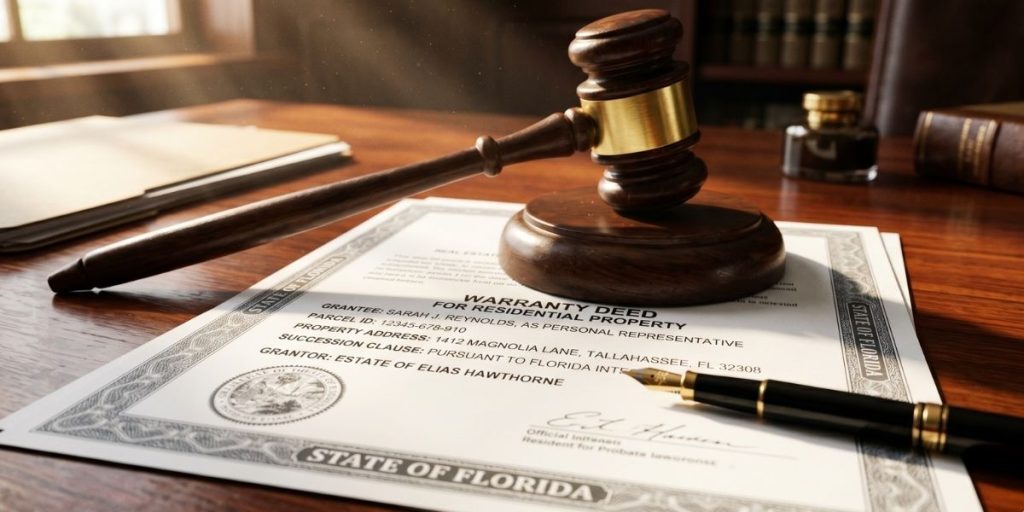
Intestate Succession Real Estate is the set of Florida rules that decide who inherits real property when an owner dies without a valid will, but those rules do not automatically produce a sale-ready title. Florida law may identify heirs at the moment of death, yet buyers, lenders, and title insurers usually treat the property as “stuck” until probate administration (or a valid nonprobate transfer) creates the documentation needed to deliver marketable title.
What Intestate Succession Means for Florida Real Estate Titles
Intestate succession is the statutory inheritance system that applies when a person dies without a valid will. In Florida, that system can answer the family’s biggest question quickly, which relatives inherit and in what shares, but it rarely answers the closing table’s question: who can sign a deed that a title company will insure.
That distinction is why out-of-state heirs, local beneficiaries, and real estate investors run into delays even when everyone “knows” who the heirs are. A title search has to connect the last recorded owner to the present seller with court-backed paperwork, homestead determinations where relevant, and proof that the right people are conveying the property. Florida’s intestacy rules are grounded in statutes (including Florida Statutes 732.102 and 732.103), but title clearance is a practical, document-driven process.
“Inheritance rights” vs. “clear/marketable title”
“Inheritance rights” describes the heir’s legal interest created by statute when an owner dies intestate. It is real, and it matters for family rights and probate administration. Marketable title is different: it is title that can be conveyed, insured, and financed without reasonable doubt or exposure to later claims.
A common pattern in Florida is that an heir has an ownership interest in theory, but cannot complete a sale or refinance because a title underwriter will not accept a family agreement, informal paperwork, or a hand-signed “heir affidavit” as a substitute for probate authority. These issues often stay invisible for months or years, then surface the moment a contract is signed, a lender asks for title insurance, or an investor attempts to close.
Why Florida real estate gets “stuck” more often than other assets
Real estate is unforgiving because ownership is public and transfer rules are formal. A deed has a specific legal description, a chain of recorded conveyances, and a set of potential clouds on title that can survive death, such as mortgages, judgment liens, code enforcement liens, HOA balances, and unpaid property taxes. Even when heirs are cooperative, someone still needs legal authority to sign seller documents, deliver warranties (or disclaim them), and satisfy closing requirements.
Florida properties also raise Florida-specific questions that financial accounts often do not. Homestead status can change who receives the property and what interests they receive. Creditor issues can affect timing. If the decedent lived out of state but owned a Florida condo, the Florida county where the property sits may still require a Florida probate proceeding to clear title, sometimes through ancillary probate.
Which Florida Property Is (and Isn’t) Controlled by Intestate Succession
Intestacy governs probate assets, meaning property that must pass through a court-supervised estate administration to change legal ownership. The practical rule in Florida real estate is simple: if the deed shows the decedent owned the property individually, intestacy usually controls who inherits, but probate administration usually controls how title becomes transferable. If the deed shows survivorship or the property is held in a trust, intestacy may never apply to that asset at all.
Understanding this boundary matters for both families and investors because it determines what can be sold quickly, what requires a court file, and what might be unavailable to the heirs entirely because it passed elsewhere by operation of law. Florida probate generally treats real estate as a probate asset unless there is survivorship language, a trust, or a form of ownership designed to pass outside probate, such as tenancy by the entirety for spouses, as discussed in this overview of probate vs. survivorship transfers.
Real estate that typically is in the intestate probate estate
Property titled solely in the decedent’s name is the classic intestate probate asset. That includes a primary residence, a vacation home, a rental house, a vacant lot, or a warehouse, so long as the recorded deed does not include a co-owner with survivorship rights and the property is not owned by a trust or business entity. A tenant in common interest also commonly falls into probate: if two siblings owned a duplex as tenants in common and one dies intestate, that deceased owner’s share is typically part of the probate estate.
Commercial real estate often lands here as well because investors frequently hold title in one name or as tenants in common, sometimes with older deeds that do not use modern survivorship language. In practice, a deed review drives the entire analysis, and the precise vesting language in the last recorded deed is often the starting point for title counsel. For a deeper walkthrough of how deeds are legally moved from a deceased owner to the next owner, see a step-by-step transfer overview.
Real estate and interests that often bypass intestacy/probate
Several common structures keep Florida real estate out of intestacy, or at least reduce the portion that needs probate.
Joint tenancy with right of survivorship can pass the decedent’s interest to the surviving joint owner by operation of law. For married couples, tenancy by the entirety is a common form of ownership and typically transfers to the surviving spouse outside probate if the marriage and the deed’s vesting are valid.
Revocable living trusts can also bypass intestacy for trust-owned property. If the trustee holds title, the successor trustee can often sign documents to sell or manage the property without opening a full probate for that asset, though title companies still require trust certificates, death certificates, and proof of successor authority.
Florida does not use transfer-on-death deeds the way some other states do. Planning conversations often reference “TOD deeds,” but Florida practice more commonly involves enhanced life estate deeds (often called Lady Bird deeds) for a similar effect. The key point for title is not the nickname, it is whether the recorded instrument is recognized and properly executed, a nuance highlighted in this discussion of Florida’s approach.
Homestead is not “just another asset”
Homestead can change the inheritance outcome even when intestacy already supplies an answer. Florida homestead has constitutional and statutory protections that can restrict who receives the property and what kind of ownership interest they receive, particularly when there is a surviving spouse or minor children. In title work, homestead is often treated as a separate decision tree that sits on top of intestacy and can force extra petitions, orders, and recorded evidence before a closing can proceed.
Who Inherits Under Florida Intestacy (and How That Changes the Title Stack)
Florida’s intestacy statute follows a hierarchy: spouse and descendants first, then parents, then siblings, then progressively more remote kin before the estate escheats. The law is rigid, which is good for predictability but tough on modern family structures. For real estate, the immediate consequence is the “title stack,” meaning how many people end up holding fractional interests and therefore must be located, verified, and involved in conveyance documents.
This is where complex lineage webs become more than a family history project. A decedent who leaves three children, with one child deceased leaving four grandchildren, can generate five inheriting branches. Two generations later, the same property can easily have 15 to 25 co-owners, many out of state, some estranged, and some difficult to identify without careful records.
Klein and Fortune’s role in this environment is often less about arguing over who “should” inherit and more about legally establishing who did inherit under Florida law. That typically means building a defensible heirship map, matching it to statutory shares, identifying homestead issues, and then producing the probate orders and recorded instruments that convert a family tree into an insurable chain of title.
Spouse and descendants: the scenarios that most often change the deed outcome
Florida’s spouse and children scenarios can make title either relatively straightforward or instantly multi-party.
If the decedent was married and had no descendants, the surviving spouse generally inherits everything, including real estate, a distribution described in this Florida intestacy summary. From a title standpoint, that can create a cleaner chain, but probate may still be needed if the property was solely titled and there is no survivorship deed.
If the decedent was married and all descendants are also descendants of the surviving spouse, the surviving spouse typically inherits everything. Again, probate documentation may be required to get from “inherits” to “can sell.”
If the decedent was married and had descendants from another relationship, the title picture changes: the spouse typically receives one-half and the descendants share the other half, a split that frequently creates fractional co-ownership and negotiation challenges, as noted in this description of the one-half split. In practice, one disinterested heir can delay an entire transaction, and one unlocatable heir can halt it.
If there’s no spouse: children, parents, siblings, and beyond
When there is no surviving spouse, Florida generally looks next to children and descendants. If there are children, they generally inherit in equal shares, with representation for descendants of a deceased child. If there are no children or descendants, the estate typically passes to parents, then to siblings and their descendants.
When the decedent has no spouse, descendants, parents, or siblings, the law keeps moving outward: grandparents, aunts and uncles, and their descendants, and in some situations the kindred of a last deceased spouse, before escheat to the state. Each step outward increases the probability of missing information, inconsistent records, and competing claims, which is exactly why investors treat intestate properties as a title-risk category rather than a simple value play.
Special family situations that frequently derail Florida title clearance
Adopted children generally inherit the same as biological children under Florida intestacy law, which means adopted heirs must be included in the heirship analysis even if extended family members try to minimize that relationship. Florida sources describe adopted children as having the same inheritance rights, including to intestate real estate, as explained in this adopted-child overview.
Stepchildren and step-siblings generally do not inherit through intestacy unless there was a legal adoption. This is one of the most common “surprise” outcomes and often triggers disputes because caregiving and family roles do not translate into statutory inheritance rights.
Florida does not generally recognize common-law marriage for intestacy. A long-term partner who was never legally married may have no inheritance rights even when the relationship was public and decades long, which is a frequent source of litigation and title clouds. Some narrow exceptions exist when a valid out-of-state common-law marriage is recognized, but that is a fact-intensive analysis that title companies rarely treat casually.
Posthumous children can also delay finality. Florida recognizes inheritance rights for a child conceived before death and born within the recognized timeframe, including the widely cited 36-week window. In a title context, this can require waiting, additional affidavits, or court findings to confirm the final heir class before a deed is considered safe to insure.
How Probate Administration Clears (or Clouds) Real Estate Title in Florida
Even when the family structure is straightforward, probate administration is typically the mechanism that converts intestate heirship into transferable title. Florida recognizes two primary probate paths: formal administration and summary administration. Both can clear title when handled correctly, but they differ in timing, court supervision, and the type of authority granted to the person managing the estate.
Title companies tend to be conservative here for a reason: probate is the system designed to confirm heirs, cut off certain creditor claims, and authorize a fiduciary to sign documents. Without probate, the transaction often has no accepted pathway to prove that the right parties are conveying the property free of estate claims.
Formal administration: when it’s required and what it does for title
Formal administration is the full probate process, typically used when the estate is more complex, when the estate does not qualify for summary procedures, or when a dispute is likely. It results in a court appointing a personal representative and issuing Letters of Administration, which are the documents that let the personal representative act on behalf of the estate.
For title purposes, those letters are often the difference between a stalled transaction and a closable one. The personal representative can manage property, negotiate payoffs, sign contracts, and ultimately execute a deed conveying estate property, subject to the estate’s needs and court requirements. Real estate professionals often see this in higher-value transactions where an underwriter wants maximum authority and a clear record. More detail on when formal administration becomes unavoidable is covered in this discussion of higher-value cases.
Summary administration: when it’s possible and the title tradeoffs
Summary administration is a streamlined probate path available in qualifying cases. It can be faster and less administratively heavy, and it can still produce court orders that establish who receives the property and authorize transfers. That said, summary administration is not “probate-free,” and it does not eliminate the need for careful title work, particularly when there are liens, disputed heirs, or homestead complications.
From a marketability standpoint, the tradeoff is that summary administration may provide less ongoing court supervision, so the paperwork must be clean and the facts must fit. Many buyers and lenders are comfortable if the summary administration order clearly identifies beneficiaries and the recorded instruments align with the order. When timing is the priority, investors often look for cases that can legitimately proceed through summary administration, a concept explored further in this summary-track overview.
Why “we’re the heirs” is not enough for a sale
Real estate deals fail in intestate situations for predictable reasons. The seller side cannot produce authority to sign, the buyer side cannot get title insurance, or the lender side cannot verify that title will be marketable after closing.
Common blockers include an unclear creditor picture, missing heirs, or uncertainty about whether the property is homestead and therefore subject to extra protections. Even when all heirs verbally agree, one later claim from an omitted heir, an unpaid lienholder, or a creditor can create quiet title risk. That is why title insurers routinely demand probate milestones and recorded documentation, and why investors who promise “quick close” without verifying probate status often end up renegotiating or walking away. The practical realities of what gets demanded at the closing table are addressed in what happens during a probate closing.
Florida Homestead Rules: The Intestacy Wild Card for Real Estate Titles
Homestead is often the moment Florida probate stops feeling intuitive. The property might be “the house,” but legally it can be a protected homestead with special rules about creditor protection and inheritance restrictions. Those rules can override expectations, especially where a surviving spouse or minor child exists.
For title purposes, homestead is not a label someone picks. It is a fact-driven classification tied to primary residence and intent, and it can require court confirmation. Title insurers care because the wrong homestead conclusion can put the wrong party on the deed, and that is the fastest route to an uninsurable chain of title.
When property is likely homestead, and why the label matters
Practically, property is likely homestead when it served as the decedent’s primary residence in Florida and met the conditions used for homestead treatment. Evidence can include the address used for driver’s license, voter registration, tax exemptions, and where the person actually lived. The label matters because homestead has creditor protection characteristics and, more importantly for intestate estates, it can change what interests pass to heirs.
Families sometimes assume a homestead exemption on the tax roll answers everything. It helps, but it is not the whole analysis for title. Underwriting usually looks for a coherent record: occupancy facts, marital and minor-child status, and probate filings that align.
Spouse/minor child protections that can change who ends up on title
Homestead can produce outcomes that look strange to non-Florida heirs. One commonly cited example is that when a decedent leaves a spouse and minor children, the surviving spouse may receive a life estate while the descendants receive the remainder interest, meaning the children’s interest exists but is not possessory until later. Florida sources summarize this concept, including the spouse life estate and descendants’ remainder, in this homestead explanation.
Even when intestacy would otherwise suggest a clean spouse-only inheritance, homestead can force a different result. Minor children are often the trigger for heightened scrutiny. From a transaction perspective, life estates and remainder interests complicate sales because multiple interest holders may need to join, and court approval may be needed in certain circumstances to protect minors’ rights.
Homestead determinations and title documentation
When homestead is in play, title companies often look for specific documentation: petitions to determine homestead status, orders identifying heirs, and recorded instruments that match the court’s findings. If the case includes minor children, additional protective steps may be necessary, and the “right” paperwork depends heavily on the family facts and the probate path chosen.
This is an area where specialized legal guidance pays for itself because the objective is not merely to distribute property within a family, but to create a record that survives underwriting and supports a future sale or refinance. Related homestead planning and protection concepts are discussed in a deeper look at Florida homestead protections.
Debts, Mortgages, Taxes, and Creditor Claims: Why Heirs Can’t Treat Title as “Free and Clear”
Intestate heirs often learn the hard way that inheritance is not the same thing as receiving an unencumbered asset. A property can be inherited and still be subject to a mortgage, tax arrears, association liens, code enforcement fines, or estate creditor claims. In Florida, heirs’ interests may be contingent until estate obligations are addressed, a principle explained in this discussion of contingent heir interests.
For investors, this is not just a legal nuance. It determines whether a deal can close on time and whether a “discounted” property is actually discounted after payoff, penalties, and curative work.
Mortgage payoff and lender requirements after death
A mortgage does not disappear at death. Payments remain due, insurance and escrow must stay current, and the lender generally expects an authorized party to communicate about payoff statements, loss mitigation, or assumptions. In intestate situations, that authority is often the court-appointed personal representative, or a successor owner recognized by the lender and supported by probate documentation.
When payments fall behind during family uncertainty, foreclosure pressure can rise quickly, especially on vacant properties. Avoiding that spiral typically requires early coordination between probate counsel and the parties managing the property. For situations where foreclosure is already looming, the practical risk management steps are covered in a guide to preventing probate-era foreclosure.
Liens, HOA/COA balances, and code enforcement issues
Florida properties frequently carry association obligations, and associations can be aggressive about collections. Estoppels, past-due assessments, special assessments, and violation fines can all affect the net proceeds of sale. Code enforcement liens and municipal fines are also common, particularly for vacant or poorly maintained properties.
These encumbrances typically survive the owner’s death and must be paid, negotiated, or otherwise resolved to deliver marketable title. Title work in intestate cases often involves a parallel track: probate to establish authority and heirship, and lien resolution to clear the property for closing.
Probate claims timeline and why investors care
Probate includes creditor claim rules and timelines that influence when a closing can safely occur. Title insurers and cautious buyers may require that certain notices be published, that claim periods run, or that the estate reach a particular procedural stage before insuring title without broad exceptions.
Even when a buyer is willing to accept some risk, a lender usually is not. That gap is why cash investors sometimes close sooner with carefully structured contracts, while financed buyers must wait for cleaner probate posture.
Common Title Problems in Florida Intestate Real Estate (and How They’re Usually Solved)
Most title defects in intestate Florida real estate fall into a handful of categories. Each has a typical solution, but solutions tend to be legal and administrative rather than purely transactional. This is also the point where “complex lineage webs” stop being theoretical. The longer someone owned property and the more generations involved, the more likely it is that the heir list is incomplete or the chain of title has gaps.
Klein and Fortune’s work in these cases focuses on turning uncertainty into a record: identifying the legally correct heirs, addressing disputes through the proper forum when needed, and producing deeds and court orders that title insurers can rely on. The process is often similar to the work described in clearing inherited title defects, where the objective is not merely to sign a deed, but to eliminate the reasons a title underwriter would refuse to insure.
Missing heirs, unknown heirs, and heir-location challenges
Missing heirs can be innocent, such as a cousin who moved and changed names, or structural, such as a branch of the family tree no one documented. Title companies tend to treat “unknown heirs” as a serious risk because an omitted heir can appear later and claim an ownership interest.
Heirship affidavits may help in limited situations, but many cases require formal probate filings, genealogical research, or court determinations that identify the full heir class. Out-of-state heirs add a logistical layer: coordinating signatures, notarizations, apostilles where applicable, and ensuring consistent names across documents.
Multiple heirs creating fractional ownership (and forced co-ownership)
Intestacy is a machine for creating tenants in common. One generation can become four owners. The next can become twelve. Soon, a small home might be owned by dozens of people, each with a fractional interest and each needing to cooperate for a sale.
This forced co-ownership produces predictable problems: disagreements over price, holdouts demanding side payments, owners who cannot be found, and disputes about who should pay taxes, insurance, repairs, and association dues. When voluntary cooperation fails, Florida law provides a legal path to force a resolution through partition, a remedy discussed in how partition resolves co-owner deadlocks.
Blended families and disputes over who qualifies as an heir
Blended families are where intestacy collides with modern expectations. A decedent may have raised stepchildren as his own without adopting them. A long-term partner may have shared expenses and caregiving for decades without marriage. Verbal promises may have been made to a niece who provided care.
None of those facts automatically change intestate heirship in Florida. When money is on the line, disappointed parties may challenge the heir list, the existence of a marriage, or the legitimacy of a claimed descendant. Those disputes can stall probate, create lis pendens filings, and make title uninsurable until resolved.
Prior conveyances, deed errors, and breaks in the chain of title
Many intestate title problems have nothing to do with heirs and everything to do with paperwork. Common issues include a wrong legal description, a misspelled name, an unrecorded deed, an old mortgage that was paid but never satisfied of record, or a deed that used ambiguous vesting language.
Death magnifies these issues because the person most able to explain what happened is no longer available to sign corrective instruments. Curative work may require quiet title actions, reformation, probate orders, or carefully structured deeds executed by a personal representative with court authority.
Selling, Buying, or Financing an Intestate Florida Property: What Closings Actually Require
The closing table is where theory becomes a checklist. The buyer and lender want confidence that the seller has the legal right to convey the property, that the conveyance will cut off claims, and that title insurance can be issued without unacceptable exceptions. Intestate properties can absolutely be sold, but the sale typically happens only after the estate has produced a clean authority path and resolved the obvious encumbrances.
A practical view of timelines and document flow is helpful, especially for out-of-state heirs juggling travel, work, and family dynamics. Separate from the probate court process, there is also the transaction choreography of a probate sale, covered in what to expect at a probate closing.
Documents that often show up on the title company checklist
The exact list varies by property and county, but intestate Florida real estate closings often rely on a familiar set of documents. Letters of Administration (formal administration) or a summary administration order are common foundations. The recorded deed conveying title out of the estate is usually required, along with a certified death certificate and recorded probate documents that link the decedent to the party signing.
If homestead is relevant, title may require petitions and orders determining homestead and heirs, plus affidavits addressing family status. Payoff and estoppel letters are also routine: mortgage payoffs, HOA or COA estoppels, municipal lien searches, and tax status confirmations.
How the personal representative signs, and when heirs must sign
In many formal administrations, the personal representative is the transactional actor. That person signs the listing agreement (if used), the contract, seller disclosures, and the deed conveying title from the estate to the buyer. This can simplify execution when there are many heirs, because it reduces the signature count and puts authority in one fiduciary.
Heirs usually become signers when the property has already been distributed to them and they hold title as tenants in common, or when the court order requires heir participation for a specific reason. This difference matters because a deal that looks “simple” on a family call can become complex if it turns into a 14-signer deed with remote notarizations across multiple states.
Timing expectations and deal-structure considerations for investors
Investors often treat intestate properties as opportunities, but the opportunity is in patience and process, not in speed. Summary administration can move faster when eligibility is clear and the heir list is clean. Formal administration can take longer, particularly when homestead issues, creditor problems, or disputes exist.
Deal structures tend to reflect that reality: longer closing windows, probate contingencies, earnest money strategies that account for delays, and extensions tied to specific probate milestones. Investors who assume a “cash close in ten days” without probate authority frequently spend more time renegotiating than closing.
FAQs and Misconceptions About Intestate Succession and Florida Real Estate Titles
“Do heirs automatically own the house when someone dies in Florida?”
Florida law generally treats ownership as shifting at death to an estate, trust, or heirs rather than leaving property ownerless. But “owning” in a statutory sense is not the same as having marketable title. In most intestate real estate situations, probate administration is still needed to create deed-ready, insurable title.
“Can we use a small estate affidavit to transfer Florida real estate?”
Florida’s commonly used mechanisms are formal administration and summary administration, not an informal small-estate affidavit that cleanly transfers deeded real estate for title insurance purposes. Even when summary administration is available, a court order and proper recording are typically what title companies want to see for a sale or refinance.
“If everyone agrees, can we skip probate to sell the property?”
Family agreement helps, but it does not eliminate creditor issues, homestead constraints, or the underwriting standards that govern title insurance. A buyer with a lender and a title policy requirement generally cannot close on a handshake and unanimous consent alone. Probate or another legally recognized transfer path is usually required.
“What happens if there are no heirs?”
Florida law continues through progressively more remote relatives before property escheats to the State of Florida. Escheat is typically a last resort after the statutory order is exhausted and the relevant searches and proofs are made. For investors, “no heirs” is not a shortcut, it often means more procedural work before title can be cleared.
When to Get Legal Help (and What to Prepare Before You Call)
Intestate Florida real estate is rarely a DIY category, not because families cannot agree, but because title insurance standards and Florida homestead rules require precise legal handling. The situations that create the biggest delays are predictable, and preparing the right information early can cut weeks or months off the timeline.
Klein and Fortune approaches these matters with a title-first mindset: identify the legally correct heirs under Florida intestacy law, document the lineage with admissible proof, address homestead status, and then complete the probate or litigation steps needed to deliver an insurable deed. That is how rightful ownership gets established in a way that supports a sale, transfer, or refinance instead of creating a future title dispute.
Situations that almost always require a Florida probate/real estate attorney
Professional help is usually needed when the family structure is complex or the transaction risk is high. Common triggers include blended families, alleged spouses or partners, minor children with potential homestead protections, unknown or missing heirs, disputes over heir status, significant debts or liens, commercial property, and any sale on a short deadline.
Litigation risk is another trigger. When heirs disagree, when an excluded party threatens a claim, or when the chain of title is broken, a transaction can require court intervention beyond routine probate. In those scenarios, the dispute-resolution path can resemble the process described in real estate probate litigation matters.
Information and documents to gather to speed up title clearance
Efficient title clearance starts with documents that anchor identity, ownership, and family relationships. A complete package typically includes the last recorded deed and legal description or parcel ID, a certified death certificate, and marriage or divorce records that clarify spouse status. It also helps to collect a written list of relatives with contact information, including children, prior spouses, and deceased family members whose descendants may inherit.
On the property side, mortgage statements, HOA or COA account information, property tax status, insurance information, and any prior title policy can dramatically speed up lien resolution and underwriting. Any trust documents, beneficiary designations relevant to real estate planning, or recorded life estate deeds should also be located early, even if family members assume intestacy applies.
How to prevent a repeat: estate planning moves that keep real estate out of intestacy
The cleanest way to avoid intestate title problems is to keep real estate out of default heirship rules. A valid, updated will can at least express intent, but for title efficiency, trust planning and properly structured deed strategies often do more to reduce probate friction, especially for out-of-state owners of Florida property.
Consistency matters: estate documents, beneficiary designations, and real estate titling should align so one plan does not contradict another. Estate plans also age, both because families change and because laws change. Many Florida practitioners recommend a review cycle every three to five years, and sooner after major life events, a cadence echoed in this guidance on review frequency. Once that habit is in place, future heirs are far less likely to inherit a property that cannot be sold.
Frequently Asked Questions
How does Intestate Succession Real Estate affect an out-of-state heir trying to sell a Florida property?
Out-of-state heirs commonly face two hurdles: Florida court requirements and title insurer requirements. If the decedent owned Florida real estate, a Florida probate proceeding may be needed to clear title, and if the decedent lived elsewhere, ancillary probate may be required in the county where the property is located. The sale usually cannot close until legally recognized authority exists to sign and convey.
Can an investor buy an intestate Florida property directly from heirs before probate is finished?
An investor can contract around timing, but title transfer usually still depends on probate authority or a legally recognized nonprobate transfer. Without probate documentation, a deed from “the heirs” can be uninsurable, especially if homestead, unknown heirs, or creditor issues exist. Many investors structure agreements to close after specific probate milestones are met.
Why do title companies insist on probate documents when heirs are clearly identified?
Title companies insure risk, and intestate cases can hide risks that are not visible in family conversations, such as omitted heirs, homestead restrictions, unresolved liens, and creditor claims. Probate documents create a court-backed record that links the last recorded owner to the present transfer and reduces the chance of a later ownership challenge.
What happens if one heir refuses to sign for a sale?
If heirs hold title as tenants in common after distribution, one holdout can block a voluntary sale. When negotiation fails, Florida law may allow a partition action that forces a sale or division, depending on the property and circumstances. This is one reason intestacy frequently turns one property into a long-running co-ownership problem.
Does Florida allow transfer-on-death deeds to avoid probate for real estate?
Florida is widely described as not recognizing transfer-on-death deeds for real estate in the same way some other states do. Planning strategies often use other tools, such as properly executed trust planning or enhanced life estate deeds, but each approach has technical requirements and must match the owner’s family and homestead situation to work as intended.