
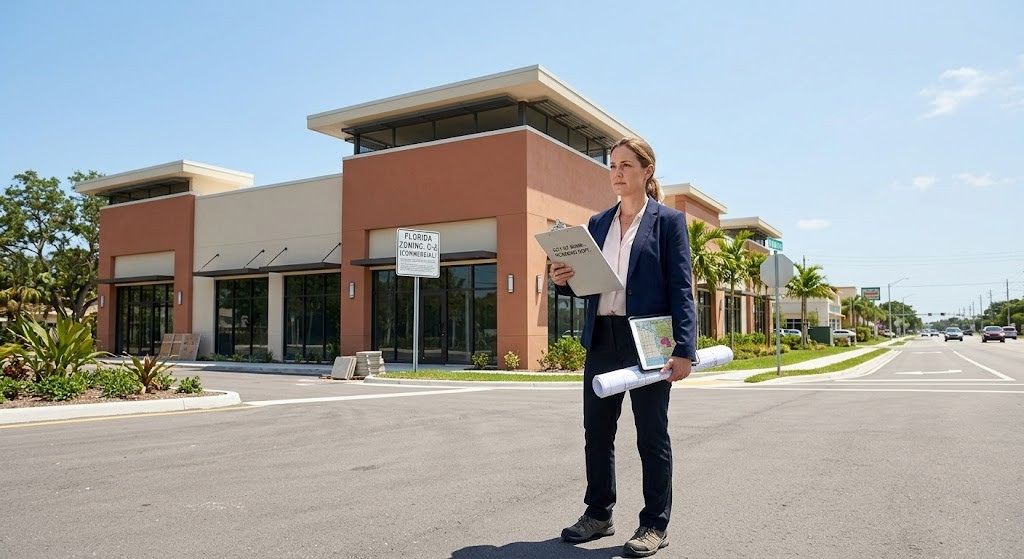
Florida Commercial Zoning Laws are the local ground rules that decide what you can actually do with a property, and they matter long before closing day. A site can look perfect on a flyer, sit right off Federal Highway, and still turn into a problem if your intended use, parking, signage, or buildout does not fit the code.
What Florida Commercial Zoning Laws Actually Cover
In plain English, Florida Commercial Zoning Laws control how land and buildings can be used. That includes obvious things, like whether a property can hold a retail shop, office, warehouse, or restaurant. It also includes less obvious things, like how tall a building can be, how far it must sit from the property line, how many parking spaces it needs, what kind of signs you can install, whether outdoor storage is allowed, and how a site can be expanded or divided.
Here’s the thing: “commercial” is not one big catchall label. A property can be zoned for some commercial uses and not others. A professional office, auto repair shop, urgent care clinic, liquor-serving restaurant, and self-storage facility may all fall under very different rules even though each is a business use.
The other catch is that zoning in Florida is usually local. That means the rules are typically set and enforced by a city or county, not by one single statewide code for every parcel. A property in Hollywood can be regulated differently from a similar property in Fort Lauderdale. A parcel in unincorporated Broward County can follow a different zoning map and development code from a parcel one block away inside city limits.
So when you hear “Florida Commercial Zoning Laws,” think of a local rulebook, not a statewide one-size-fits-all answer.
Why Zoning Needs a Hard Look Before You Close
Zoning review belongs in due diligence because a deed does not fix a bad fit. If your intended use is not allowed, or only allowed with extra approvals, the problem starts the moment you take title. By then, your leverage is gone and the clock is running on carrying costs, loan obligations, tenant expectations, or construction plans.
A zoning problem can hit from several angles. Your business use may be prohibited. The existing building may not comply with parking, setbacks, or site design rules. Prior owners may have added improvements without permits. A property may need landscaping upgrades, drainage work, or a formal approval before you can open or remodel. None of that is visible from the glossy brochure.
This is where deals often fall apart at City Hall. A listing may say “great for medical,” “ideal restaurant location,” or “fully operational office.” Nice language. Not legal confirmation.
Zoning Problems Can Survive the Sale
Closing does not erase zoning issues. If a building addition was done without approval, that problem stays with the property. If the site has open code violations, those can become your cleanup project. If a prior user changed operations without proper authorization, you may inherit the consequences even if the building has been occupied for years.
One of the most common mistakes is assuming current use equals lawful use. It does not. A current tenant may be operating as a legal nonconforming use, which means the use survives only under limited rules. Or the use may have expanded beyond what was approved. Or the space may never have received the right certificate of occupancy for that business type.
That distinction matters a lot. “Someone is there now” is not the same thing as “your use is lawfully permitted now.”
A Quick Broward County Example
Picture a buyer under contract for a small commercial building near Federal Highway in Hollywood. The plan is to convert it into a medical office with a few treatment rooms. On the surface, it feels simple. The area is busy, the building already looks office-like, and the seller says similar businesses operate nearby.
Then zoning review starts. The district may allow general office by right, but a medical use could fall into a narrower category that needs extra review, more parking, or a special approval. If the site is short on parking or sits in an overlay district with added standards, the deal suddenly gets slower and more expensive.
That kind of surprise is common. And it is much cheaper to find it during the inspection period than after the wires are sent.
How Commercial Zoning Works in Florida
The system gets easier once you break it into three layers. First comes the comprehensive plan, which is the long-range vision for land use. Next comes the zoning district, which applies parcel-level rules. Then the land development code fills in the details about what the district actually requires.
Think of it like a road trip. The comprehensive plan is the big map. The zoning district is the route you are allowed to take. The development code is the fine print about speed limits, lane widths, and where you can stop.
Comprehensive Plan vs. Zoning District
The comprehensive plan is the big-picture land use framework. It guides how areas are expected to grow over time, such as commercial corridors, residential neighborhoods, industrial areas, and mixed-use centers. It matters because zoning changes usually need to stay consistent with that larger policy structure.
Zoning is more direct. It tells you what can happen on a specific parcel today, subject to the code. If the comprehensive plan says an area is intended for commercial activity, that does not mean every commercial use is automatically allowed on every lot in that area. Zoning is the day-to-day rulebook.
Local Governments Make the Rules
Cities, towns, and counties adopt and enforce zoning codes. So the first question is not just “What is the zoning?” It is also “Who has jurisdiction over this property?”
That answer changes where you search records, which zoning map controls, which code applies, and which staff members issue interpretations or approvals. A property in Fort Lauderdale goes through Fort Lauderdale’s rules. A property in Hollywood goes through Hollywood’s. A parcel in unincorporated Broward County goes through Broward County’s code and departments.
If you start in the wrong place, you can waste a lot of time reviewing the wrong standards.
Zoning Maps and Land Development Codes
For most deals, two tools do the heavy lifting: the zoning map and the land development code.
The zoning map tells you the district assigned to the parcel. That might be an office district, business district, industrial district, mixed-use district, or something more specialized. The code then tells you what that district means in practice. That is where you find use tables, setback rules, height limits, floor area rules, parking ratios, landscaping requirements, signage standards, lighting rules, and site design standards.
Both matter. The map gives you the label. The code tells you whether the label works for your deal.
The Commercial Zoning Classifications You’ll See Most Often
Every Florida jurisdiction has its own naming system, so labels vary. Still, the structure is pretty similar from place to place.
Office, Retail, Industrial, Mixed-Use, and Special Districts
Office districts usually allow professional and administrative uses, such as legal offices, accounting firms, and some medical or business services. Retail or business districts tend to allow stores, restaurants, personal services, and consumer-facing operations, though often with plenty of conditions.
Industrial districts are built for warehousing, manufacturing, distribution, contractor yards, or heavier business activity. Mixed-use districts combine commercial and residential uses, often with design standards meant to create a walkable corridor or downtown feel. Special districts can include downtown districts, transit-oriented districts, corridor districts, or overlay areas with added rules for appearance, signage, access, or permitted uses.
The trick is not to rely on the district name alone. “General business” sounds broad, but the use table may still treat a clinic, late-night restaurant, or auto use very differently.
Permitted, Conditional, and Prohibited Uses
This is one of the biggest concepts to understand before closing.
A permitted use, sometimes called allowed by right, means the use is allowed in that zoning district if you meet the code standards. You still may need permits and site review, but you do not need a special public approval just to place that use there.
A conditional use or special exception means the use may be allowed, but only after an added review process. That often involves an application, staff review, public notice, and a hearing before a board or commission. Approval may come with conditions about hours, access, buffers, parking, or operations.
A prohibited use is exactly what it sounds like. The district does not allow it.
That is why “commercial” is not enough. You need to know which bucket your exact business use falls into.
What You Need to Verify Before Closing on a Commercial Property
This is where zoning review turns from theory into deal protection. Before money changes hands, you want clear answers about use, compliance, approvals, and hidden restrictions.
Is Your Intended Use Allowed Right Now?
Start with the exact use. Not “office.” Not “commercial.” Not “service business.” Find the code’s actual term for what you plan to do. A medical office may be listed differently from a business office. A restaurant with alcohol can be treated differently from a cafe. Indoor storage may not equal warehouse.
Then confirm whether that use is permitted by right, allowed only with a special exception or conditional approval, or barred entirely. Written confirmation matters here because zoning staff may use code-specific definitions that differ from the label in your business plan.
Does the Existing Building Comply?
A building can host a lawful use and still have site compliance problems. Check setbacks, height, lot coverage, parking counts, loading areas, signage, outdoor storage, and any visible additions or enclosures. Review access and circulation too. If the site was altered over time, the current layout may not match approved plans.
Accessibility issues also matter in practice. Zoning is not the same as ADA compliance, but site access, ramps, parking layout, and paths of travel can affect whether a space is realistically usable without more work.
Are There Open Code Violations or Unpermitted Work?
This part gets missed all the time. Pull code enforcement records, permit history, certificates of occupancy, and, where useful, business tax receipt history. If a buildout happened with little or no permit trail, slow down.
Old violations do not become less real because the paint looks fresh. If an owner enclosed a patio, converted storage to occupiable space, installed signage without approval, or changed use without permits, fixing that after closing can cost far more than anyone expected.
Are There Overlay, Historic, Coastal, or Environmental Restrictions?
Some parcels have extra layers on top of base zoning. Overlay districts can impose design standards, access controls, signage limits, or use restrictions. Historic districts may require review before exterior changes. Floodplain and coastal rules can affect redevelopment, utilities, elevation, drainage, and insurance. Tree preservation and environmental requirements can reduce the buildable area that looked available on a simple site sketch.
The site may look generous on paper but feel much smaller once these layers are applied.
How to Check a Property’s Zoning in Florida
You can start this process the same day you get serious about a property.
Start With the Parcel and Jurisdiction
Get the exact street address, legal description, and folio or parcel number. Then confirm whether the property is inside Hollywood, Fort Lauderdale, another Broward municipality, or unincorporated Broward County. That step sounds basic, but it prevents reviewing the wrong code.
Property appraiser records can help identify parcel details, but ownership and tax records are not zoning approval. Use them as a starting point, not the finish line.
Review the Zoning Map and Use Table
Next, look up the parcel on the applicable zoning map. Once you have the district, open the local land development code and find the use table for that district. Match your intended use to the code’s exact term.
That is the trick. Search for the legal label used in the code, not the everyday label used in a listing brochure. “Clinic,” “medical office,” “personal service,” “assembly,” “warehouse,” and “restaurant” can each have narrow definitions that change the answer.
Request Written Zoning Confirmation
Verbal conversations with planning staff are helpful, but they are not enough for a serious transaction. If available, request a zoning verification letter, written email confirmation, or another written statement identifying the district and whether your intended use is permitted, conditional, or prohibited.
A written answer gives you something solid to evaluate during due diligence. It also helps your lender, design team, contractor, and counsel work from the same assumptions.
Check Permit, Code, and Certificate Records
Review permit records, certificates of occupancy, prior site plans, code cases, and past approvals. These records show whether the use and improvements are legal, not just visible. A clean parking lot and occupied building can hide years of improvised changes.
If the property “almost works,” the record trail often explains why.
Variances, Special Exceptions, and Rezoning: What Happens If the Property Almost Works
Some properties are close fits. That can still be workable, but you need to understand the relief path and the risk.
Variance
A variance is permission to deviate from a specific dimensional rule in limited circumstances. Think setbacks, lot width, height, or sometimes parking layout. It is usually about the physical rules of the site, not a free pass to install a use the district does not allow.
So if your building sits too close to a property line, a variance may help. If your intended business is prohibited in the district, a variance usually will not solve that.
Special Exception or Conditional Use
Some uses are allowed only after public review. That review often looks at compatibility with nearby properties, traffic, noise, hours, parking, and operational impacts. If approved, the use may come with conditions attached.
Common examples can include drive-thrus, automotive uses, certain medical uses, alcohol-related uses, or more intensive commercial operations. The process can be perfectly manageable, but it adds time, cost, and uncertainty.
Rezoning and Future Land Use Changes
Rezoning means changing the property’s zoning district. That is often the biggest lift because it changes the rules that apply to the parcel going forward. In some cases, a future land use amendment may also be required if the existing comprehensive plan designation does not support the requested zoning.
That means a longer timeline and a less predictable outcome. If your deal only works after rezoning, treat that as a development play, not a simple acquisition.
Other Rules That Can Affect the Deal Even When Zoning Looks Fine
Zoning is only one layer. Plenty of deals run into trouble somewhere else.
Building Codes, Permits, and Certificates of Occupancy
A use can be allowed by zoning and still require major work before opening. Building permits, fire review, occupancy approvals, grease traps, utility upgrades, accessibility work, and life-safety improvements all live in separate lanes from zoning.
A restaurant is the classic example. Zoning may allow it, but the space may still need ventilation upgrades, plumbing changes, fire suppression work, and occupancy approval before it can operate.
Private Restrictions, Leases, and Association Rules
Private documents can limit use too. Declarations, reciprocal easement agreements, commercial condominium documents, shopping center restrictions, and lease terms may block uses that zoning would otherwise allow.
So even if the city says yes, private restrictions can still say no. That is especially common in retail centers and mixed-use projects.
Licensing and Operational Rules
Some businesses need more than zoning approval. Health-related uses may need licensing. Alcohol sales can trigger local distance separation rules or extra approvals. Childcare, medical, food service, and certain personal service businesses often have separate operational standards.
Zoning is one green light. It is not the whole traffic signal.
Common Misunderstandings About Florida Commercial Zoning Laws
A few misconceptions cause a lot of avoidable trouble.
“Commercial Zoning Means Any Business Can Go There”
No. Commercial zoning is a category, not a blank check. Different commercial districts allow different uses, and many businesses fall into narrow code definitions. A site zoned for office and retail may still reject auto service, medical treatment rooms, or late-night food and beverage uses.
“The Current Use Must Be Legal”
Also no. An operating business is not proof of compliance. The use could be legal nonconforming, expired, expanded without approval, or simply never challenged. Occupancy is not the same as entitlement.
“If the Seller Says It Works, That’s Enough”
Seller information helps, but it is not verification. Public records, zoning confirmation, permit history, and approval documents matter more. Honest sellers can still be wrong, especially when a property has changed hands or uses several times.
“You Can Fix Zoning After Closing”
Sometimes you can. Often you cannot, or not cheaply. This is one place for a hard rule: zoning due diligence before closing is always cheaper than trying to unwind a bad assumption later.
A Simple Due Diligence Checklist for Buyers, Investors, and Property Managers
If you want a clean way to pressure-test a deal, focus on records, approvals, and obvious warning signs.
Documents and Records to Request
Pull the survey, title commitment, zoning designation, applicable use table, approved site plans, certificate of occupancy, permit history, code enforcement records, environmental reports, and any prior variance, special-exception, or rezoning approvals. If the property is in a commercial association or governed development, pull those documents too.
That stack tells you far more than the brochure ever will.
Questions to Ask the Planning or Zoning Department
Ask direct, plain questions. Is the intended use permitted by right? Is there a legal nonconforming use on the site? Are there open violations or unresolved approvals? Do parking, signage, and site layout comply? Are overlays, pending code changes, or corridor standards in play?
Good zoning questions are specific. Vague questions get vague answers.
Red Flags That Should Slow the Deal Down
Pay attention when the story sounds fuzzy. “It’s grandfathered” with no paperwork is a red flag. So is a recent conversion with almost no permit history, obvious parking shortages, site plans that do not match the current layout, or a business type that needs a public hearing before approval.
If the property almost works, assume you need more paper before you need more optimism.
When It Makes Sense to Get Zoning and Legal Help
Some deals deserve a deeper review from the start. Redevelopment sites, adaptive reuse projects, industrial parcels, restaurant deals, medical office conversions, mixed-use property, and anything involving code issues or title concerns can get complicated fast.
This is not about making a simple deal feel dramatic. It is about saving time and avoiding ugly surprises. If the value of the deal depends on a use change, a variance, a special exception, or a clean legal status for existing improvements, careful zoning and legal review usually costs less than one bad closing.
Frequently Asked Questions About Florida Commercial Zoning Laws
Can a commercial property be used for any type of business in Florida?
No. A commercial property can be used only for uses allowed under its specific zoning district and any overlay or special rules that apply. Some uses are permitted by right, some need extra approval, and some are prohibited.
Who enforces commercial zoning laws in Florida?
City or county governments usually enforce local zoning codes. The enforcing authority depends on the property’s jurisdiction, such as Hollywood, Fort Lauderdale, another Broward city, or unincorporated Broward County.
What is the difference between a variance and a rezoning?
A variance adjusts a specific rule, usually a dimensional requirement like setback or height. A rezoning changes the property’s zoning district, which can change the permitted uses and development standards.
Can a nonconforming use continue after a sale?
Sometimes, yes, but the rules are narrow and local. Rights tied to a nonconforming use can be lost through abandonment, expansion, or an unapproved change in use. That status should be confirmed in writing before closing.
What should you do first before closing?
Verify the exact zoning district and your intended use in writing before the inspection period runs out. That one step catches a surprising number of bad assumptions early, while you still have room to renegotiate, request documents, or walk away.