
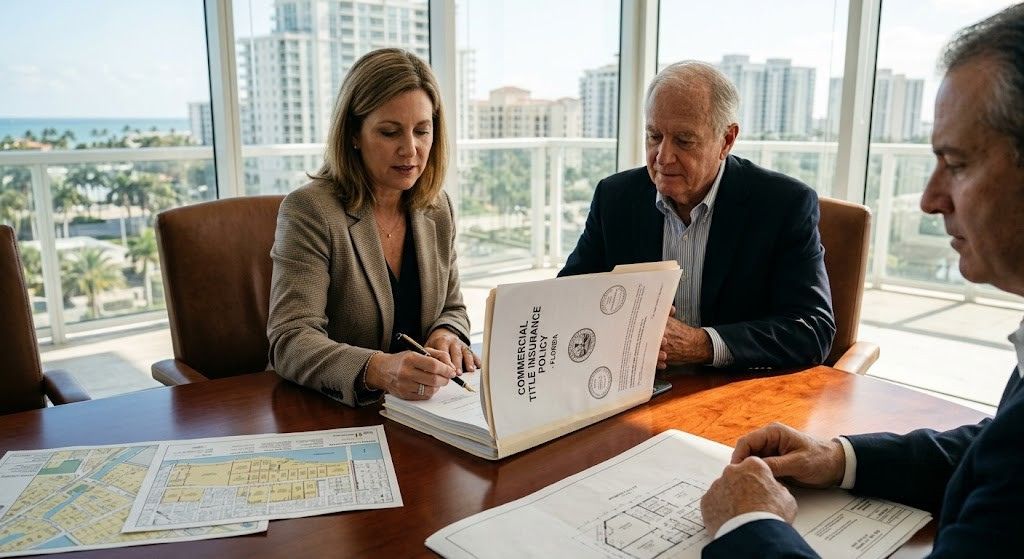
Commercial Title Insurance Florida protection covers ownership problems tied to a property before you buy it, and that matters a lot more in a business acquisition than most deals make it seem. If the business comes with land, a building, or a long-term lease, skipping title review is like buying a car without opening the hood. Everything can look polished at closing and still hide a problem expensive enough to wreck the deal later.
What Commercial Title Insurance in Florida Actually Covers
Commercial title insurance protects your ownership interest, and often a lender’s interest, against title defects that already existed before closing. In plain English, it helps if somebody else has a legal claim against the property, if a prior lien was never released, if public records contain an error, or if a past transfer was invalid because of fraud or forgery.
That sounds abstract until money is on the line. In a business acquisition, you are not just buying income or equipment. You are often buying the place that makes the business work. If title to that place is messy, your financing can stall, your operations can get disrupted, and your resale value can drop fast.
Owner’s Policy vs. Lender’s Policy
An owner’s policy protects your stake in the property. If a title problem shows up later, this is the policy tied to your ownership.
A lender’s policy protects the bank’s loan, not your equity. That distinction trips people up all the time. If financing is part of the purchase, both policies are often in the deal, and one does not replace the other. The bank wants protection for the amount it lent, while you want protection for the value you bought.
Why “Commercial” Title Insurance Is Different From Residential
Commercial deals usually carry more moving parts. The price is higher, the property history is longer, and the legal paperwork tends to be messier. Office, retail, industrial, and mixed-use sites in Broward County often come with old easements, shared parking arrangements, prior mortgages, tenant rights, entity transfers, and use restrictions that simply do not show up in a basic single-family home purchase.
Here’s the thing: commercial title issues are rarely small. A minor-looking access problem can affect deliveries. A forgotten lease term can affect rentable space. An old utility easement can interfere with expansion plans. The policy matters, but the review before the policy matters just as much.
Why Title Protection Is Vital When You’re Buying a Business
When a business acquisition includes real estate, the property side deserves the same attention as the financial statements. A business can look profitable on paper, but the catch is the land or building underneath it may still carry hidden legal baggage.
That baggage can interfere with financing, delay your closing, limit how you use the property, or make a future sale harder. If your plan depends on keeping tenants in place, adding signage, expanding parking, or maintaining uninterrupted access, title problems stop being legal technicalities and become business problems overnight.
Real Estate Problems Can Become Business Problems Overnight
Picture a commercial site just off Hollywood Boulevard. The income numbers work, the location is strong, and the closing date is circled on the calendar. Then a title review or survey turns up an old easement cutting through the rear of the property, right where delivery trucks have been using the lot for years.
Suddenly, this is not just a property issue. It affects operations, access, maybe even tenant satisfaction. The same kind of surprise can block financing, trigger a dispute over parking, complicate permit approvals, or interfere with occupancy. In commercial deals, one title defect can touch everything at once.
Common Title Risks in Florida Commercial Deals
Some risks show up again and again in Florida commercial transactions. Unpaid liens are claims for money owed that attach to the property. Recording errors are mistakes in public records. Boundary disputes happen when property lines are unclear or inconsistent with actual use. Unknown heirs can surface if an earlier owner’s estate was not handled properly.
Then there are forged documents, unreleased mortgages that were paid off but never formally removed from record, access issues involving driveways or entry points, easements that give outside parties certain rights over the property, and survey conflicts where legal descriptions do not match improvements on the ground. Municipal permit and code issues are not always covered by title insurance itself, but they often surface during the same due diligence process and can still affect the deal in a very real way.
Why Florida Transactions Need Extra Attention
Florida adds extra layers. Older chains of title can be messy. Waterfront and flood-prone areas can involve unusual legal descriptions, access concerns, or layered restrictions. Condo, office-retail, and mixed-use structures can include shared elements and common-area rights that need careful review.
Local practice also matters. Closing customs and cost allocations can differ by county, and Broward County does not always mirror Miami-Dade. That does not change the core rule, though: the contract controls, and assumptions are expensive.
What the Title Search and Due Diligence Process Usually Looks Like
A lot of buyers picture title insurance as a document handed over at closing. That is only the final step. Before any policy gets issued, there is usually a review process meant to uncover problems early enough to fix them, insure around them, or renegotiate the deal.
That early window matters. Problems found two weeks before closing are frustrating. Problems found two days before closing are a disaster.
The Title Search
The title search is a review of public records tied to the property. That includes ownership history, mortgages, judgments, tax liens, easements, restrictions, and other recorded matters. You will often hear the phrase chain of title, which simply means the property’s ownership history from one owner to the next.
The goal is to confirm that the seller actually has the right to transfer the property and to spot claims or defects that could affect your ownership.
The Title Commitment
The title commitment is basically a preview of the policy the insurer is willing to issue. It lists the proposed insured parties, the requirements that must be satisfied before closing, and the exceptions, meaning the items the policy will not cover unless something changes.
This is where deal friction often shows up. An old lien may need to be released. A missing document may need to be recorded. A shared access issue may need closer review. If you only glance at the commitment, you miss the part of the process that does the most work.
Survey, Zoning, and Access Review
Commercial title insurance works best when paired with a current survey and a practical review of how the property is actually used. A survey can reveal encroachments, boundary inconsistencies, access routes, easements, and parking layouts that are not obvious from the legal description alone.
Zoning and use matter too. Title insurance does not magically confirm that your intended use fits local rules. If your business plan depends on a specific use, delivery pattern, signage setup, or parking count, you need that checked separately and early.
What Commercial Title Insurance Does and Does Not Protect
A standard policy covers specific title-related risks. It does not fix every property problem automatically, and that misunderstanding causes a lot of frustration.
Think of it like insurance for the legal ownership foundation of the property, not a blanket warranty for every issue connected to the site.
Issues a Policy Typically Covers
A commercial title policy typically covers undisclosed liens, ownership disputes, mistakes in the public record, forgery, fraud in prior transfers, and other defects tied to title. If somebody later claims an interest in the property based on a covered issue from before closing, the policy can provide defense and financial protection within its terms.
That protection is real, and it is one of the smartest parts of the closing budget.
Common Exceptions You Should Notice Before Closing
Exceptions are the items the policy does not insure unless they are removed or modified. Common examples include survey matters, unrecorded claims, certain tenant issues, environmental conditions, zoning compliance, and known defects.
The catch is that buyers sometimes focus on having a policy at all and ignore what the policy excludes. In commercial deals, those exclusions can matter just as much as the coverage itself.
When Endorsements Matter in Commercial Deals
Endorsements are add-ons that expand or tailor coverage for particular risks. In commercial acquisitions, endorsements often address access, contiguity between parcels, zoning-related matters, leasehold interests, or survey-based concerns.
If the property value depends on legal access, multiple connected parcels, or tenant operations, the right endorsement can make the policy fit the deal instead of just sitting in the file.
How Costs, Negotiation, and Closing Responsibility Work in Florida
One of the most common practical questions is simple: who pays for title insurance in Florida? The short answer is that local custom can influence expectations, but the signed purchase agreement decides it.
That matters even more in commercial transactions, where everything is more negotiable.
Who Usually Pays for Title Insurance in Florida
Florida has county-based customs, especially in residential deals, but commercial transactions are less tied to convention. In some places, one side commonly pays for the owner’s policy. In others, the expectation shifts. Broward County practice can differ from Miami-Dade, which is exactly why assumptions create problems.
If financing is involved, the lender’s policy, endorsements, and related closing costs may also be split or assigned differently depending on the deal terms.
Why the Purchase Agreement Matters More Than Assumptions
Your contract should spell out who pays for the owner’s policy, lender’s policy, endorsements, survey, and closing services. If that language is vague, small cost disputes can become annoying delays.
More importantly, the purchase agreement is where you lock in responsibility before deposits go hard and timelines tighten. That is the moment to fix assumptions, not the week of closing.
What Affects Commercial Title Insurance Cost
Cost usually depends on the purchase price, loan amount, policy type, endorsements, and overall deal complexity. A straightforward warehouse purchase will not look the same as a mixed-use property with tenant leases, shared access, and multiple parcels.
Yes, extra review and extra coverage can raise the upfront cost. But honestly, that is often cheap compared with the price of discovering a preventable title problem after closing.
Smart Questions to Ask Before You Close
The smartest approach is not to assume the title process is handling everything in the background. A quick huddle before signing can save months of cleanup later.
Questions for the Title Company or Closing Team
Ask direct questions. Are there unreleased liens? What exceptions will remain on the policy? Is a new survey recommended? Are legal access and parking rights clear? Are there endorsements worth adding based on the property type and deal structure?
Those questions are simple, but the answers tell you where the real risk sits.
Questions for a Business Acquisition Involving Existing Tenants or Operations
If the property comes with tenants or an ongoing business, look closely at lease estoppels, rent assignments, service access, signage rights, and common-area rights. You also want to confirm whether daily operations depend on easements, shared drive aisles, loading areas, or other use arrangements that need to be documented.
If the business only works because everyone has been informally doing things a certain way, that is a red flag.
One Smart Move to Try First
Request the title commitment early and actually review it before the closing calendar gets tight. That is the easiest first move, and it gives you time to fix problems, negotiate around them, or walk away before the deal becomes expensive to unwind.