
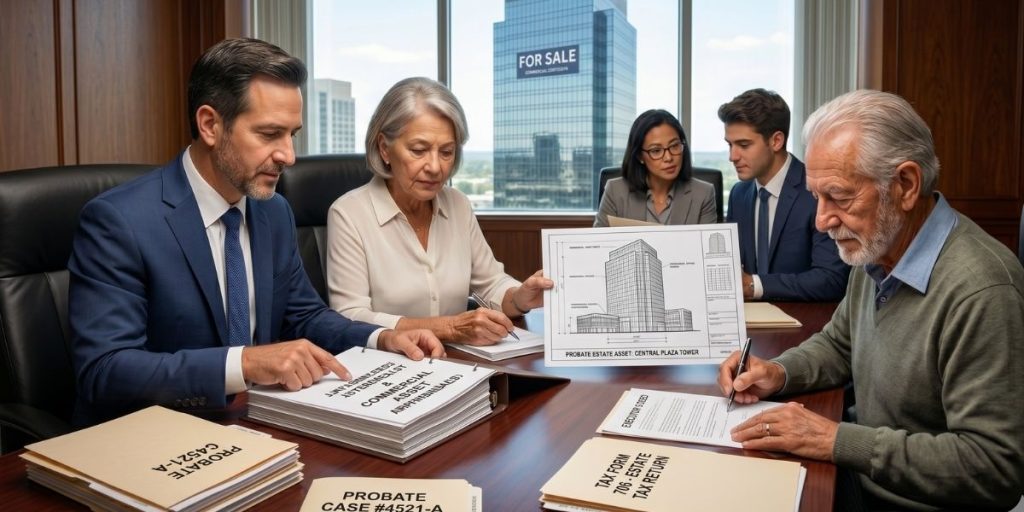
Commercial Real Estate Probate is the court-supervised administration and transfer of a deceased owner’s commercial or income-producing property, and it tends to feel less like a normal sale and more like running a business while a judge watches the paperwork. The friction is rarely about finding a buyer, it is about proving authority, clearing title, keeping tenants stable, and meeting Florida probate procedure without creating liability or delay.
What “Commercial Real Estate Probate” Means (and Why It’s More Complex Than a Typical Sale)
Commercial real estate probate is the legal process for administering an estate that includes commercial property such as a retail strip, office condo, warehouse, mixed-use building, or leased land. The estate becomes the “seller,” acting through a court-authorized personal representative, and every meaningful action flows from that authority: signing listing agreements, approving repairs, negotiating a lease issue, and signing the deed at closing.
The reason it is more complex than a typical commercial transaction is simple: probate adds a court process on top of an already document-heavy asset class. A commercial sale already involves leases, rent rolls, operating statements, lender requirements, and due diligence that tends to be deeper than residential. Probate adds appointment timelines, required notices, creditor claim windows, and sometimes court approval of the sale itself. Even when everyone is cooperative, some steps cannot be skipped.
Florida adds its own procedural realities. Florida probate is state-specific, court-driven, and deadline-based, and the county court’s calendar can influence deal timing as much as any buyer. The higher the value and the more stakeholders involved, the more likely it becomes that a transaction needs extra documentation, extra notice, or extra patience. That is why a sophisticated legal team matters in commercial probate. When a building is tied to disputes among beneficiaries, conflicts with business partners, loan defaults, or tenant litigation, a firm with deep business litigation experience is not a bonus feature. It can be the difference between a clean closing and a prolonged fight that bleeds value.
Commercial vs. Residential Probate Real Estate: Key Differences That Change the Playbook
Residential probate often centers on occupancy, repairs, and simple title transfer. Commercial probate, by contrast, is frequently an operating asset with people and contracts attached to it. Tenants expect service. Vendors expect payment. Lenders expect compliance. Buyers expect a clean package that matches the income story.
Several differences tend to change the playbook:
Commercial assets carry ongoing obligations, like common area maintenance (CAM) reconciliations, service contracts, and property management reporting, even while probate is pending. Leases can require consent for assignment, impose notice requirements, or grant renewal options that affect value. Buyers and lenders often request tenant estoppels and SNDAs, which can become time-consuming when multiple tenants are involved. Environmental risk is also more common, especially with industrial, older retail, automotive, dry cleaner, or redevelopment-adjacent sites. The diligence scope expands, and so does the list of people who can slow the deal.
Who Has Authority to Act: Personal Representative, Executor, Heirs, Trustees, and Investors
Probate deals fail most often at the starting line, when someone negotiates before confirming who is legally allowed to act. In Florida probate, the personal representative (often called an executor when named in a will) is the person who can bind the estate. He or she has fiduciary duties and court-supervised responsibilities, and that role is not interchangeable with “oldest child,” “majority of heirs,” or “the family’s preferred decision-maker.”
Heirs and beneficiaries may have economic rights, such as the right to receive distributions. That is not the same as signing authority. Trustees, if the property is owned by a trust, may have authority outside of probate, but only if title is actually in the trust and the trust is properly funded. Investors can negotiate and perform diligence, but their contract must be signed by the correct party with the correct authority, and it must match any court requirements that apply.
For out-of-state families, this is where misunderstandings multiply. A child may be handling everything day-to-day but not yet appointed. A will may exist but not be admitted. A “family agreement” may be unanimous but not legally binding. A buyer may be ready to close but cannot obtain title insurance because authority and title are not ready. That is why early coordination with probate counsel and the closing agent is a practical necessity, not a formality. A helpful companion topic is the mechanics of deed transfer, because the deed in probate is not just a standard seller deed, it is an estate conveyance tied to authority and court file history, as explained in a clear overview of deed transfer after death.
The One Document Everyone Will Ask For: Letters of Administration / Letters Testamentary
Letters of Administration (or Letters Testamentary) are the court-issued document that proves the personal representative’s authority to act for the estate. Title companies, lenders, and sophisticated buyers insist on seeing them because the letters show who can sign, and sometimes what limits exist on that person’s powers.
The practical reality is that the letters function like an estate’s ID card. A buyer does not want a contract signed by someone who cannot deliver title. A title insurer does not want to insure a deed signed without authority. Even brokers and property managers will often request letters before taking instructions on leasing, security deposits, or vendor contracts.
In commercial probate, a copy of the letters should be obtained early, saved to the deal file, and checked for currency. If the letters are old, expired, or superseded by later orders, the closing can stall. If the estate has co-personal representatives, the letters may require both signatures. If authority is limited, the contract may need court approval language from day one.
Common Authority Pitfalls That Blow Up Deals
Several authority mistakes recur in commercial probate transactions, and each one tends to surface late, after time and money have been spent.
Multiple personal representatives can create signing confusion, especially if the letters require joint action and one person is unavailable or uncooperative. Disputed appointments are another frequent deal-killer. If a beneficiary is contesting the will or objecting to the personal representative, buyers see risk, and lenders often pause.
Informal “family agreements” also cause trouble. Even when all heirs agree on price and terms, the estate still needs the proper signer. Powers of attorney are commonly misunderstood as a workaround, but in most cases they end at death and do not replace probate authority. Unprobated wills, lost wills, or ambiguous estate planning documents can create a gap between what the family believes should happen and what the court will allow.
In higher-value estates, these disputes can merge into broader conflicts: arguments about valuation, accusations of self-dealing, or disagreements about whether to sell versus hold. A firm with a sophisticated business litigation background becomes especially valuable in these moments, because the legal team can respond quickly when a transaction turns into a contested matter, or when a threatened lawsuit starts to impact timing, disclosures, and closing certainty.
Florida Probate Pathways That Affect Commercial Property: Summary Administration vs. Formal Administration
Florida generally offers different probate pathways, and the chosen track can materially affect commercial property timing and deal structure.
Summary administration is a simplified process available in limited circumstances, typically when an estate qualifies by value thresholds and other factors. It can reduce procedural weight, but it is not a universal fast pass, and commercial properties often push estates outside of easy eligibility. Formal administration is the more common pathway for commercial assets and higher-value estates. It involves appointing a personal representative, issuing letters, inventorying assets, addressing creditor procedures, and following court-driven steps through to distribution.
The practical difference for a sale is that formal administration tends to produce the cleanest chain of authority for operating and selling a commercial building, especially when there are tenants, contracts, or significant liabilities. Many commercial buyers actually prefer the structure of formal administration because it clarifies who can sign, how claims are handled, and what court oversight exists. For families hoping for speed, it helps to understand why summary may or may not apply. For a deeper discussion of the shortcut pathway and what it can realistically accomplish, this explanation of Florida’s summary track for real estate is a useful reference point.
When Ancillary Probate Is Triggered (Out-of-State Owners or Multi-State Portfolios)
Ancillary probate generally arises when a decedent owned property in more than one state, and additional probate proceedings are needed where the out-of-state property is located. Commercial owners trigger this more often than families expect because portfolios are commonly spread across states, and ownership structures can be layered.
Even when the primary probate is open elsewhere, Florida courts only have jurisdiction over Florida property. So a Florida commercial building owned by a non-Florida resident commonly requires a Florida case in the county where the property is located, coordinated with the main estate proceedings. This coordination impacts closing schedules and costs, and it changes how quickly letters can be issued and deeds recorded.
Ancillary also becomes relevant when entity planning is incomplete, for example when some properties are in an LLC and others are still in an individual’s name. For out-of-state heirs who need a Florida-centered roadmap, this guide to ancillary proceedings lays out the concept in plain terms and helps set expectations about timelines and paperwork.
The Probate Timeline Reality: Why Closings Commonly Take 90+ Days (and Sometimes 6, 24 Months)
Commercial probate closings often take at least 90 days, and many take far longer, because probate has built-in waiting periods and court steps that do not compress just because a buyer is motivated. Standard commercial sales already have longer diligence periods than residential. Probate adds appointment timing, inventory deadlines, creditor notice windows, and potential court approval steps.
Across jurisdictions, sources commonly describe probate real estate timelines as taking 6, 12 months, and complex or contested estates can extend into the 6, 24 month range. The cause is usually procedural rather than market-driven. Even “cash buyers” cannot skip the legal need for authority, clean title, and court compliance.
What does this mean on the ground? A buyer may perform inspections quickly, but the estate still has to produce letters, gather records, resolve title issues, address creditor claims, and, when required, obtain court approval before closing. Commercial property magnifies all of this because leases, tenant issues, and environmental diligence tend to add time even in non-probate deals.
A Practical, Phase-by-Phase Timeline for Commercial Real Estate Probate Administration
A commercial probate file tends to move through recognizable phases, although the pace depends on the court, the attorney’s filing cadence, and the condition of the asset.
The early phase centers on opening the case and obtaining appointment. Petitions are filed, interested parties are identified, and the personal representative is appointed. The milestone document is the letters, because that is the switch that turns authority on. Without letters, the estate may be limited to protective actions rather than binding sale steps.
Next comes inventory and valuation. The estate identifies and documents assets, including the commercial property, and often begins appraisal work or broker opinions of value. In commercial files, this phase also includes assembling leases, rent rolls, and operating statements so the asset can be priced and marketed responsibly. The output is usually a combination of court filings and a deal package for buyers.
Creditor procedures follow, including notices and a period for claims. Even when claims are not expected, prudent administration assumes they might exist, especially for commercial assets with contractors, lenders, municipal exposure, or business obligations. Buyers and title companies may request clarity on whether claims exist and whether any sale proceeds need to be held back.
Contracting and court approval, when required, sits next. A contract may be signed by the personal representative, but it often includes probate contingencies and longer timelines. In some scenarios, additional notice to interested persons or court confirmation is needed, which can create a “two-step” process: contract execution, then court authorization or confirmation.
Closing occurs when the estate can deliver a deed with clear authority and insurable title, and when any payoff, proration, tenant estoppel, and escrow conditions are satisfied. The final phase is distribution and reporting, when proceeds are applied to expenses and claims, then distributed to beneficiaries under the plan and court supervision.
What Speeds Things Up vs. What Slows Things Down
Speed in commercial probate rarely comes from hustle alone. It comes from removing avoidable uncertainty.
Organized records move cases forward: a current rent roll, readable leases, service contracts, and recent financials give buyers confidence and reduce diligence extensions. Clean title and proactive lien searches prevent “surprise” defects late in the transaction. Prompt valuation, whether via appraisal or a credible pricing package, reduces beneficiary disputes and helps justify the deal if court scrutiny arises. Responsive heirs and a personal representative who documents decisions clearly also reduce friction.
Delays, by contrast, come from contested estates, missing deeds, old liens, and tenant problems that become legal problems. Code violations and municipal liens can take time to resolve. Environmental flags can add weeks for a Phase I, longer for a Phase II. Court calendar congestion is real, and hearings move. Operational distress, like unpaid insurance, deferred maintenance, or a property slipping toward default, adds urgency but not speed. If foreclosure risk is present, the timeline becomes even more sensitive, and a separate, practical discussion of preventing probate-time foreclosure becomes relevant because saving the asset can matter more than marketing it.
Inventory, Valuation, and Due Diligence: What Makes a Commercial Probate File “Complete”
A complete commercial probate file is one that can satisfy three audiences at the same time: the court, the beneficiaries, and the buyer’s underwriting team. The court expects accurate identification and valuation of assets and proper administration steps. Beneficiaries expect a transparent process that protects value. Buyers expect documentation that supports income, reduces unknowns, and makes title insurable.
In commercial property, “inventory” is not just the building. It is also the agreements and obligations that create the building’s value and risk profile: leases, deposits, guaranties, vendor contracts, signage rights, easements, and sometimes intangible business elements when a property is connected to an operating company. If the decedent ran a business in the space, the probate file may overlap with business succession issues, licensing, and equipment ownership.
This is where legal sophistication becomes a practical asset. When due diligence reveals a dispute with a tenant, a former partner, or a vendor claiming rights, a team with business litigation depth can evaluate risk early and guide strategy: settle, litigate, escrow, or restructure the transaction to close without inviting post-closing lawsuits.
Commercial Property Documents You’ll Want to Assemble Early
Commercial probate administration goes smoother when the estate assembles a coherent document set early, even if some items are incomplete and need follow-up.
The documents that tend to matter most include leases and a lease abstract, a current rent roll, trailing twelve-month income and expense statements (T-12), CAM budgets and reconciliations, and any delinquency history that could become a buyer objection. Service contracts, warranties, permits, and evidence of code compliance often matter more in commercial than families expect, especially for properties with HVAC systems, elevators, fire suppression, or specialized buildouts. Surveys, legal descriptions, and easement documents reduce boundary-related surprises.
Environmental documents are also part of “completeness.” If any Phase I or Phase II reports exist, they are worth locating early. If none exist, the estate should expect that a serious buyer or lender will order them for many asset types, and the probate timeline needs to absorb that reality.
Insurance history matters too. A pattern of claims can affect insurability and pricing, and in Florida’s insurance market, that can become a major transaction variable. If the building is held in an LLC, entity records also matter, because buyers may need to confirm whether they are buying the real property or membership interests, and whether the operating agreement restricts transfer.
Appraisals in Probate: Court Needs vs. Market Needs
Probate valuation serves multiple purposes, and those purposes are not always aligned.
The court’s interest is accurate reporting and fair administration. Beneficiaries may focus on whether the value supports a sale decision or a distribution plan. Buyers care about whether the income and condition support their underwriting assumptions, and lenders care about collateral value.
In commercial probate, appraisals can reduce disputes by anchoring value, especially when siblings disagree on price or when an investor’s offer feels “too low” but reflects real issues like vacancy, deferred maintenance, or lease rollover risk. Timing matters. If an appraisal is ordered late, marketing and contract timing can slip, and court filings may need updates.
Appraisal strategy is also influenced by deal structure. If a sale requires court approval or heightened scrutiny, a defensible appraisal can help justify the transaction and protect the personal representative from later accusations that the asset was undersold. In high-value estates, that protection can be as important as the number itself.
Title and Ownership Challenges Unique to Inherited Commercial Property (Florida Focus)
Title is the quiet force that decides whether a probate deal closes on time. In commercial probate, title issues tend to be more frequent because properties have longer ownership histories, more financing events, more recorded easements, and more opportunities for old documents to be missing or inconsistent.
Title companies often flag probate-related gaps such as missing links in the chain of title, inconsistent owner name formats, unreleased mortgages, or improper prior transfers. Inherited commercial property can also involve unrecorded assignments of leases, undocumented easement rights used for years, or boundary issues that no one noticed because the property “worked” operationally. Probate surfaces these issues because a buyer’s title insurer will not accept assumptions.
Families sometimes assume that probate itself clears title automatically. It does not. Probate provides authority and a court-supervised path to transfer, but defects still have to be cured. When disputes arise around ownership, boundaries, or prior transfers, the path can shift from routine administration to formal dispute resolution. In those situations, a strong understanding of probate-focused title disputes matters, and this overview of resolving contested title issues offers context on how litigation can become part of the clearance process.
Common Title Defects in Commercial Real Estate Probate
Some defects are mundane but time-consuming: unreleased mortgages, old satisfaction documents that were never recorded, and small liens that balloon with interest or fees. Others are structural: missing deeds, improper legal descriptions, boundary or survey conflicts, or recorded easements that interfere with the site’s use.
Municipal liens and code enforcement items are particularly common in Florida, especially when a property has been under-maintained during illness or after death. Unpaid property taxes can also create closing constraints, and HOA or COA liens can appear in mixed-use or commercial condo settings.
Name mismatches are another hidden trap. A deed might be in a slightly different version of the decedent’s name, or in the name of an entity that was dissolved years ago. Fixing these issues can require affidavits, corrective deeds, or court orders, and each fix has its own timeline.
Entities, Partnerships, and Trusts: When It’s Not Just “Probate the Building”
Many commercial properties are not owned in a simple individual name. They may be held in an LLC, a partnership, a corporation, or a trust. That changes what probate even means.
If the building is owned by an LLC, the decedent may have owned membership interests, not the real estate directly. Probate may control the transfer of those interests, while the entity continues to own the property. The operating agreement may restrict transfers, define successor managers, or require consent from other members. In a partnership, buy-sell provisions can dictate what happens at death, sometimes forcing valuation and buyout procedures rather than a sale of the underlying property.
Trust-owned properties can avoid probate for the real estate if the trust is properly funded and title is in the trust, but “paper trusts” that never received a deed do not solve the problem. Investors and heirs need to confirm what is actually being sold: fee simple title, a leasehold interest, a partial interest, or an entity interest. Getting this wrong can lead to a contract that cannot close, or worse, a closing that produces litigation later.
This is another area where business litigation experience is a real advantage. Entity disputes often resemble business divorce problems more than probate paperwork, and resolving them may require negotiating with partners, enforcing operating agreement rights, or litigating control issues quickly to prevent value loss.
Managing Tenants, Leases, and Cash Flow During Probate (Without Creating Liability)
Commercial probate administration is not only about transfer. It is also about operations, because the asset must be protected while authority and court steps unfold.
The personal representative typically has a duty to secure and preserve estate property. In a commercial setting, that means maintaining insurance, collecting rents, keeping utilities and life-safety systems functioning, and responding to legitimate maintenance needs. Neglect can create liability, trigger tenant defenses, or cause insurance cancellations that make the property unmarketable.
Out-of-state families often underestimate how much active management is required. A property that runs “on autopilot” still needs accounting, vendor oversight, and tenant communication. If the decedent was the informal property manager, knowledge may be trapped in emails, a notebook, or unwritten understandings with tenants. Reconstructing that operational history becomes part of probate diligence.
Lease Issues That Can Delay or Kill a Sale
Lease friction is one of the fastest ways to blow up a commercial probate timeline.
Buyers often request tenant estoppel certificates to confirm key lease terms: rent, term, options, deposits, and whether defaults exist. Tenants may delay signing, request concessions, or dispute amounts. If a lender is involved, SNDAs may be required, and some tenants negotiate them aggressively.
Assignment and consent clauses can create another delay. A buyer may need lease assignments, and some leases require tenant consent or specific notice periods. Renewal options, rights of first refusal, and termination rights can affect value and may require careful disclosure.
Delinquent tenants add complexity because eviction or collection is time-consuming, and probate does not pause tenant disputes. If a major tenant is in conflict, the estate may face a decision: resolve the dispute to stabilize value or sell with the problem disclosed, accepting a lower price.
Property Management in Probate: When to Keep, Replace, or Add a Professional Manager
In commercial probate, professional management is often the stabilizing force that protects cash flow and reduces legal risk. The decision is not about convenience, it is about fiduciary duty and documentation.
If an existing manager is competent and transparent, keeping them can preserve continuity and tenant relationships. If the existing manager is informal, under-documented, or entangled with the family, replacing them can reduce conflict and improve reporting. When no manager exists and heirs are out of state, adding a manager is often the only realistic way to maintain insurance compliance, vendor control, and accurate accounting.
Good management also supports the sale process. Clean monthly statements, organized lease files, and documented repairs reduce buyer uncertainty. If the estate later faces complaints that the property was mismanaged during probate, management records become evidence of prudent administration.
Creditor Claims, Taxes, and Estate Expenses: How They Impact Net Proceeds and Closing Strategy
Commercial probate is as much about who gets paid as it is about who gets the building. Creditor procedures influence timing, and they influence how proceeds may be handled at closing.
Creditors may include lenders, contractors, municipalities, vendors, and sometimes business counterparties. Probate procedures commonly require notice and provide a window for claims. Even when the estate expects minimal claims, the sale strategy should anticipate how payoffs and holdbacks are handled, because title companies and buyers want clarity on liens and post-closing risk.
Estate expenses also shape strategy. A commercial property can bleed cash during probate: insurance, utilities, security, landscaping, repairs, and professional fees. If the property is underperforming or vacant, the estate may have to fund these expenses while waiting for authority and court steps, which can push families toward a faster sale even at a lower price.
Taxes add another layer. While this article does not provide tax advice, commercial estates often involve depreciation history, entity considerations, and multi-state tax filing. These issues influence net proceeds and should be addressed before signing a contract that assumes a certain distribution.
Expenses That Commonly Surprise Heirs and Investors
The surprises in commercial probate are rarely glamorous, but they are expensive.
Insurance is often the first shock, especially if a policy lapses or must be rewritten because the named insured died. Security and vacancy protection can become necessary if tenants leave or if the property becomes a target for vandalism. Deferred maintenance shows up during buyer inspections, and what looked like a “minor roof issue” can become a major capex negotiation.
Legal fees, appraisal costs, property management fees, and environmental testing can also appear quickly, particularly when buyers request a Phase I or when historical use suggests risk. Eviction and tenant legal disputes are another cost center. For investors, these expenses should be treated as part of the risk premium embedded in pricing, not as negotiable “nickel and dime” items.
Capital Gains, Estate Tax, and Withholding: What to Ask a CPA Before Signing a Contract
A commercial probate sale can create tax consequences that differ dramatically depending on how the property was owned, how it was depreciated, and who is receiving proceeds. Many estates benefit from a basis step-up concept, but entity structures and prior depreciation can complicate the picture.
Out-of-state beneficiaries should be particularly careful. Multi-state filing, withholding, and residency questions can impact net distributions and timing. If the property is held in an LLC or partnership, the sale may have entity-level implications that do not mirror a simple deed transfer.
A practical rule is that tax counsel should be involved early enough to influence deal structure, not late enough to merely react to a signed contract. Coordination between the probate attorney and CPA keeps the transaction aligned with both court process and financial reality.
Selling vs. Holding: Decision Framework for Beneficiaries (and What Investors Should Understand)
Beneficiaries often frame the decision as “sell or keep,” but commercial probate adds more shades of gray: sell as-is, stabilize then sell, refinance to hold, distribute in-kind, or restructure ownership through an entity agreement.
Selling as-is is common when heirs are out of state, the property has deferred maintenance, or the estate needs liquidity to pay expenses and claims. Stabilizing and selling can produce a higher price, but it requires time, working capital, and active management during probate, plus the discipline to document decisions in case beneficiaries later challenge them. Refinancing can work when the building cash flows and heirs want to hold, but lenders may require clear authority and may be wary of probate uncertainty. Distributing in-kind is sometimes possible, but it can be a recipe for conflict if siblings become involuntary business partners without an operating agreement.
Investors evaluating probate deals should understand that the personal representative’s job is not to “get rid of the property.” The job is to administer the estate prudently. That tends to favor transparency, defensible pricing, and compliance, even when a fast sale sounds appealing.
When a Court-Approved Sale or Additional Notices May Be Required
Some probate sales require additional court involvement or notice to interested parties, depending on the estate’s posture, the authority granted, and any disputes. Even when court approval is not strictly required, the personal representative may pursue additional approval to reduce later liability, especially in high-value commercial transactions where beneficiaries might question pricing.
Additional notices and approvals change contract terms. They can introduce longer timelines, special contingencies, and sometimes a risk that the court process invites competing offers or objections. For investors, this is not inherently a deal-breaker, but it changes certainty and holding costs. For beneficiaries, it is often the trade: more oversight and protection in exchange for speed.
Executing the Sale: From Listing Agreement to Closing in a Probate-Safe Way
A probate-safe commercial sale is structured so that each step is legally supportable and operationally realistic. That starts with selecting professionals who understand probate constraints, including a broker who can package commercial financials and a closing agent who is comfortable with estate conveyances. It also requires tight coordination with probate counsel so contracts and disclosures reflect the case posture.
Pricing strategy is often where emotions and fiduciary duty collide. Heirs may anchor to a peak-market number or a neighbor’s sale. Investors may anchor to worst-case risk. Probate-safe pricing uses evidence: lease terms, vacancy, capex needs, comparable sales, and credible valuation support. The more organized the file, the less room there is for suspicion and disagreement.
During the transaction, communication matters. Commercial buyers are accustomed to structured diligence, but probate creates uncertainty. Keeping buyers engaged requires predictable milestones and proactive disclosure of issues like title defects, tenant disputes, and court timeline constraints.
For Florida-specific deal mechanics and how to avoid common delays, this guide on selling estate property without avoidable holdups connects well with the commercial context, even though commercial deals add additional layers.
Contract Terms That Reduce Probate Risk (for Both Estates and Buyers)
Well-drafted contract terms do not make probate faster, but they make it less fragile.
Common risk-reducing terms include a clear requirement that the signing party provide current letters, a probate or court approval contingency when applicable, and a realistic closing window that reflects creditor procedures and title cure time. Inspection access should account for tenant coordination and lease restrictions. Estoppel and SNDA requirements should be spelled out, including timelines and what happens if tenants delay.
Title cure periods matter more in probate. A contract that assumes clean title in 10 days is often unrealistic for inherited commercial property. Escrow instructions should address probate-specific issues such as holdbacks for unresolved liens, prorations tied to CAM, and timing for deposit release if court approval is denied or delayed.
How Commercial Buyers Underwrite Probate Deals (and How to Keep Them Engaged)
Commercial buyers underwrite risk in layers: income risk, tenant risk, physical condition risk, title risk, and timing risk. Probate increases timing risk and sometimes increases title risk, so buyers compensate by demanding more diligence, more contingencies, or more price cushion.
Keeping a buyer engaged often comes down to reducing uncertainty. A document room with leases, rent rolls, and operating statements builds confidence. A realistic milestone calendar prevents frustration. Weekly updates, even when nothing dramatic changes, signal competence. Proactive issue disclosure also matters. A buyer who discovers a code lien late feels ambushed and will often retrade or walk, while a buyer who is told early can price it rationally.
When the deal involves potential disputes among heirs, partners, or tenants, a firm with business litigation capability can support the transaction by managing conflict strategically. Sometimes that means negotiating releases. Sometimes it means seeking court guidance. Sometimes it means litigating quickly to prevent sabotage. Commercial probate is not purely transactional, and pretending it is can be expensive.
Coordination & Workflow: How Professionals Manage Complex Probate Administration Without Missing Deadlines
Commercial real estate probate is a coordination problem disguised as a legal process. There are stakeholders with different incentives, the court has its own schedule, tenants have their own priorities, and buyers have underwriting deadlines. The estates that close smoothly tend to be the ones managed like a project, with clear task ownership and consistent communication.
A workable system usually starts with a stakeholder map: personal representative, probate counsel, beneficiaries, property manager, broker, title company, lender (if any), key tenants, and major vendors. From there, a cadence is set for updates and document requests. The goal is not constant meetings, it is eliminating ambiguity about who is doing what and by when.
In high-value estates, workflow discipline also protects against allegations of mismanagement. Documenting decisions, keeping records of bids and repairs, and maintaining clean accounting is not busywork. It is defense-grade administration when family conflict or investor scrutiny appears.
A Simple Probate Deal Workflow (Checklist-Style)
- Confirm signing authority
- Engage Florida probate counsel
- Order title and municipal lien searches
- Secure property and insurance coverage
- Assemble leases and financial package
- Obtain valuation and support pricing
- Market property and negotiate contract
- Complete court-required notices and approvals
- Clear title conditions and coordinate payoffs
- Close and document distributions
Using CRMs and Automation to Track Court Dates, Notices, and Tasks
Probate administration involves deadlines, notices, and follow-ups that can slip when communication is scattered across email, text messages, and multiple family members. That is why some teams use CRM and workflow tools not as “sales tech,” but as compliance infrastructure: task reminders, centralized document storage, communication logs, and milestone tracking.
There are also reported performance claims worth treating as directional rather than guaranteed. Some sources describe AI-enhanced CRM systems as reducing cycle times by 30, 50% by automating deadline tracking and compliance notifications. Even if the exact percentage varies, the underlying point holds up in practice: fewer dropped tasks means fewer avoidable delays, especially when court dates, tenant responses, and attorney filings all have to align.
Common Misconceptions and FAQs About Commercial Real Estate Probate in Florida
Commercial probate attracts myths because people blend together three different concepts: inheritance rights, property operations, and legal authority. Clarifying these early prevents wasted effort and failed contracts.
FAQ: “Can heirs sell the property before probate is finished?”
In most probate scenarios, heirs cannot sign a binding sale contract simply because they are heirs. The estate’s authorized personal representative signs on behalf of the estate, using court-issued authority. A sale can sometimes be negotiated and even contracted during administration, but closing depends on authority, title, and any court steps required by the case.
FAQ: “Does a will avoid probate for commercial property?”
A will typically directs how probate should be handled, but it does not bypass probate by itself. Avoiding probate for real estate generally requires ownership structures that transfer outside probate, such as certain survivorship deeds, properly funded living trusts, or entity planning. Whether those tools apply depends on how the property is titled and what documents exist.
FAQ: “How long will it take to close?”
A 90+ day timeline is commonly realistic even for cooperative estates, and 6 to 12 months is a common range for probate real estate transactions. Complex estates can reach 6 to 24 months when disputes, multi-state issues, title defects, or tenant litigation are involved. The driver is usually legal and procedural timing, not buyer demand.
FAQ: “What if beneficiaries disagree about selling?”
Disagreement can slow or pause progress, especially if disputes become formal objections in court. The personal representative has fiduciary duties and cannot simply follow the loudest voice. In contested situations, probate counsel may recommend mediation or court guidance, and in some cases litigation becomes unavoidable. When co-owner conflict turns into a division problem, the legal tool is sometimes a partition case, and this explanation of partition litigation in Florida helps clarify what that path looks like.
FAQ: “Can an investor buy a probate commercial property at a discount?”
Sometimes, but it is not automatic. Discounts typically reflect real friction: incomplete records, tenant issues, deferred maintenance, environmental risk, title defects, or timeline uncertainty. Well-run probate sales with clean files can trade at market pricing, especially when the income is stable and the estate’s authority is clear.
When to Involve a Florida Probate Attorney (and What to Prepare Before the First Call)
Commercial probate is one of those areas where early legal guidance saves time, not because the attorney “pushes paperwork,” but because correct strategy from day one prevents rework and failed deals. In Florida, probate procedure is court-driven and county-specific in its practical timing, and commercial assets raise the stakes. When a property is leased, encumbered, or tied to an entity, the legal structure influences operations and sale authority immediately.
Preparing for an attorney call also reduces billable churn. When key documents are gathered early, counsel can focus on strategy: authority, title, creditor procedures, and how to structure a sale that will close.
Intake Checklist for Out-of-State Heirs and Local Beneficiaries
The most useful intake package is the one that answers basic authority and asset questions quickly: death certificate, will and any trust documents, the most recent deed and closing statement, mortgage or loan statements, property insurance declarations, lease files and rent roll (if available), known debts and vendor obligations, and a contact list for heirs and beneficiaries. If the property is in an entity, operating agreements and membership records are part of the core file, not an afterthought.
Red Flags That Require Specialized Counsel (Commercial + Probate + Title)
Certain red flags indicate that a general “probate plus closing” approach may be insufficient. Environmental concerns, contested appointment fights, multiple owners or layered entities, significant code enforcement issues, major tenant litigation, looming foreclosure, and unclear chain of title all raise the risk profile. These are the situations where sophisticated commercial counsel, including a team with business litigation strength, can protect the estate’s value and keep a sale from collapsing under pressure.
Frequently Asked Questions
How does Commercial Real Estate Probate differ when the property has an operating business inside?
An operating business can add contracts, licenses, equipment ownership, employees, and revenue streams that are separate from the real property itself. Probate may need to address both the building and the business interests, and buyers may require clarity on what transfers and what does not before underwriting a purchase.
Can a personal representative renew leases or sign new leases during probate?
A personal representative often can take operational steps to preserve estate value, which may include leasing decisions, but the scope depends on the authority granted by the court and the case posture. In commercial settings, lease decisions can materially affect sale value, so they are typically made with probate counsel and documented carefully.
What documents do commercial buyers usually demand early in a probate deal?
Buyers typically want leases, a rent roll, operating statements (often T-12), CAM information, service contracts, and evidence of insurance. They also want authority proof (letters) and early title information so underwriting is not built on assumptions.
What happens if the property is behind on loan payments during probate?
Loan default risk can force faster decisions and can limit sale flexibility. The estate may need to negotiate with the lender, cure arrears, seek a forbearance, or pursue a sale on an accelerated timeline, but legal steps in probate still apply.
Does Florida homestead protection apply to commercial property?
Homestead protections are generally associated with a primary residence, not income-producing commercial assets. In mixed-use scenarios, the analysis can become more nuanced, and probate counsel often reviews the deed and use facts to determine what protections, if any, apply.
This article is for informational purposes only and does not constitute legal advice. Accreditation requirements vary by state and payor contract. Consult with a qualified attorney regarding your specific compliance obligations.