
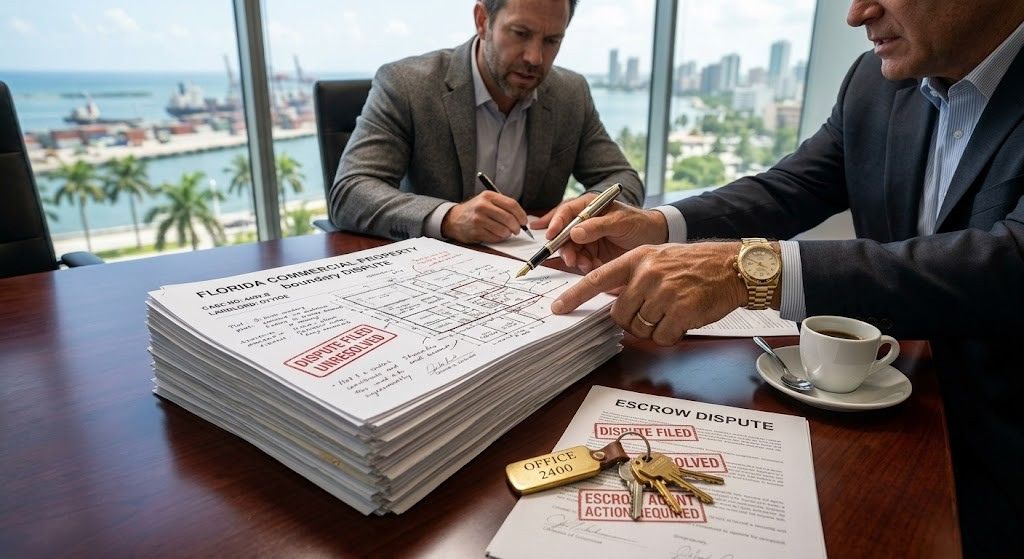
Commercial Property Boundary Disputes are disagreements about where one commercial parcel legally begins and ends, and in South Florida, that question can turn ugly fast. A fence along a rear lot line in Hollywood or a parking strip beside a Fort Lauderdale retail site can look settled for years, right up until a survey says otherwise. If you are buying, selling, leasing, refinancing, or planning a redevelopment, this is one of those issues that can quietly sit in the background and then suddenly control the whole deal.
What Commercial Property Boundary Disputes Mean in South Florida Transactions
In plain English, a commercial property boundary dispute means two sides do not agree on the property line. Sometimes the disagreement is obvious, like a wall or driveway crossing over. Sometimes it is buried in paper, where the deed says one thing, an old plat says another, and the actual site has been used a third way for twenty years.
Commercial sites make this more complicated than a backyard argument. You are not just looking at grass and a fence. You are looking at loading areas, curb cuts, signs, drainage routes, utility runs, parking layouts, and access paths that keep a business functioning. One shifted line can affect usable square footage, setbacks, traffic flow, and even tenant operations.
Why these disputes show up so often in commercial deals
Here’s the thing: commercial land gets changed more often. Parcels get split, assembled, re-striped, expanded, paved over, and repurposed. In Broward County, older sites near major corridors often carry a long history of site work that never matched the original legal description perfectly.
That creates friction. A property may have shared access with a neighbor for years, but no recorded easement. A dumpster pad may sit partly over the line because someone moved it during a renovation. A row of parking spaces may seem harmless until a redevelopment plan needs every inch to meet code. What looked “close enough” during day-to-day operations stops being close enough once money, financing, and closing deadlines enter the picture.
The Most Common Causes of Commercial Property Boundary Disputes
Most commercial boundary fights start with a mismatch between documents and reality. The ground tells one story. The file tells another. Due diligence is when those stories finally get compared.
Survey conflicts and outdated legal descriptions
One common trigger is a survey conflict. An older survey may rely on a legal description written decades ago, often using metes and bounds, which is a written boundary description based on distances and directions. If that description was vague, copied incorrectly, or built on an earlier mistake, every later transaction can carry the same problem forward.
Conflicting plats can add another layer. A recorded subdivision map may not line up neatly with later adjustments, road work, or lot changes. The result is a gap, overlap, or uncertainty about where the actual line sits. That can feel abstract until you realize the building corner, access lane, or drainage swale may be affected.
Encroachments, easements, and shared-use confusion
An encroachment is a physical improvement that crosses a property line. Think fence, wall, driveway edge, loading dock, awning, sign base, or even a strip of asphalt used for parking. In commercial settings, these are not minor annoyances. They can interfere with operations, insurance, maintenance, and development rights.
An easement is different. It is a legal right to use part of land for a limited purpose, usually for access, utilities, drainage, or ingress and egress. The catch is that many sites function as if an easement exists when nothing was ever properly recorded. A neighboring business may have used an alley connection or cross-access lane forever, but habit is not the same as documented rights. Once a deal is on the table, that informal arrangement becomes a real problem.
Title issues, access problems, and redevelopment changes
Some disputes are really title problems wearing a boundary costume. A title defect, an unrecorded lot split, a bad legal description in an old deed, or a missing easement can all create boundary uncertainty. The property may look fine on a site visit, but the title commitment and survey can expose a hole in the chain of documentation.
Redevelopment makes everything sharper. If you are assembling parcels, changing site plans, or trying to meet setback and parking requirements, a small discrepancy stops being small. Losing even a few feet at the edge of a parcel can reduce buildable area, affect stormwater planning, or complicate access approvals.
How Boundary Disputes Can Affect Your Deal
Boundary disputes absolutely can slow or derail a transaction. That is not theory. It happens because unresolved lines create uncertainty, and commercial deals hate uncertainty.
A buyer may pause or renegotiate. A seller may get hit with cure demands. A lease may need to be rewritten if parking or access is not what it seemed. A refinance can stall because the lender does not want unclear collateral. Even when the issue gets resolved, it can shift leverage during negotiations. A deal that felt smooth on Monday can become a price fight by Friday.
Risks for buyers, sellers, landlords, and developers
If you are buying, the risk is inheriting a problem that limits use, value, or resale. If you are selling, the risk is being forced to fix documentation, obtain neighbor cooperation, or accept credits and delays. If you are a landlord, unclear boundaries can trigger tenant complaints over parking, loading, signage, or shared access. If you are developing, boundary uncertainty can chip away at the exact area needed for setbacks, circulation, or code compliance.
That is why these disputes matter so much. The property line is not just a legal concept. It shapes what you can build, lease, insure, finance, and operate.
Why lenders and title insurers pay close attention
Lenders want collateral with clear, marketable boundaries. Title insurers want to know exactly what risk is being insured and what risk is being excluded. If a survey shows an encroachment or a possible access issue, the title commitment may include exceptions that reduce coverage.
That matters at closing. A lender may refuse to fund until the issue is cured, and a title insurer may refuse certain endorsements unless the boundary question is resolved. In practical terms, unclear lines can hold up the money and the policy, which means the closing does not happen.
What to Do When You Notice a Boundary Problem
The best response is calm and organized. Rushing usually makes it worse.
Start with the survey, title commitment, and recorded documents
Start by lining up the current survey, title commitment, deed, recorded plat, easements, and any available site plans. The trick is to compare what the documents say with what actually exists on the property. Look for gaps, overlaps, unlabeled use areas, access routes, and improvements near the edge of the parcel.
A fresh commercial survey often becomes the anchor document here, because it puts the legal description and physical conditions in one place.
Document the issue before anyone starts moving things
Once you spot a possible problem, document it before a neighbor, contractor, or seller tries an informal fix. Take photos. Mark measurements. Gather prior surveys, permits, emails, maintenance records, and anything showing how the area has been used over time.
That small step matters more than it seems. Facts tend to get fuzzier once closing pressure builds.
Bring in the right professionals early
Get the right professionals involved early: a commercial real estate attorney, a licensed surveyor, the title company, and, if redevelopment is in play, a land-use or zoning professional. Catching a boundary issue before closing is usually far cheaper than fighting about it after tenants move in or construction starts.
Ways Commercial Property Boundary Disputes Get Resolved
Not every boundary dispute ends in court, and honestly, many should not. But every dispute does need a clean strategy that matches the actual problem.
Negotiation and boundary line agreements
A lot of disputes can be resolved through direct negotiation. If both sides agree on a fix, the solution may involve a boundary line agreement, an easement, a license for limited use, or even a lot line adjustment. The key is recording the solution properly so the problem does not come back in the next sale.
That is often the most efficient path, especially when the issue is small but the documentation is messy.
Mediation, arbitration, and court action
Mediation is a structured settlement discussion with a neutral third party. Arbitration is a more formal private process, often required by contract. Litigation is court action.
Court may be necessary when someone refuses to cooperate, when title must be quieted, or when an encroachment needs to be stopped or removed. But informal talks usually happen first, because lawsuits are expensive and slow, especially when the business goal is simply to close and move forward.
Curative title and survey solutions before closing
Some boundary disputes are really curative work projects. A corrective deed may fix a legal description. A revised survey may clarify the actual condition. A recorded easement, affidavit, or title endorsement may resolve a risk the lender and title insurer care about.
That is good news. If the issue is caught during due diligence, the problem may be fixable without turning the transaction into a courtroom fight.
How to Reduce the Chance of a Boundary Dispute in Future Transactions
Prevention is boring right up until it saves a deal. In commercial real estate, boring is good.
Build better due diligence into the deal timeline
Give yourself enough time for a current survey, site inspection, zoning and access review, and a real title objection period. A quick walk of the perimeter can catch what a spreadsheet misses, especially around fences, alleys, rear service lanes, and loading areas.
In Broward County, where older commercial properties often carry decades of layered site changes, that walk matters more than most people expect.
Make contracts and closing documents do more of the work
Your contract should deal clearly with survey standards, title objection procedures, seller cure obligations, representations about encroachments, and what happens if a problem is not fixed before closing. Clear deal paper prevents messy phone calls later.
That is not just legal housekeeping. It changes leverage when an issue appears.
Try one simple habit before signing
Before signing, walk the property line with the survey in hand. Pay extra attention to parking edges, fences, alleys, drive aisles, and loading areas. It feels almost too simple, like checking the corners of a rug before buying the room, but this habit can save a closing.
If one thing is worth trying before your next South Florida commercial deal, it is that.